In off-road racing, it’s easy to focus all the attention on the race vehicle. That’s the machine blasting across the desert, hammering through whoops, and fighting for the finish line. But according to veteran off-road racer Brad Lovell, the race truck actually sees fewer miles than just about anything else involved in getting a team to the starting line and back home again.
Behind the scenes, there’s another vehicle doing the heavy lifting.
“The team cannot operate at all, of course, without a chase truck,” Lovell says.
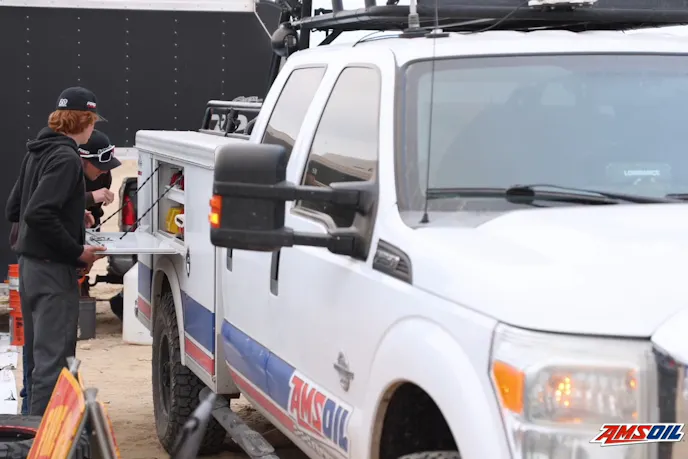
For Lovell’s operation, that vehicle is a Ford F-450 outfitted as a rolling workshop, parts department, fuel station, recovery rig, and communications center. It racks up thousands of miles traveling to and from races, tows the race vehicle across long distances, and then spends race day navigating rough access roads in conditions that can range from mountain grades to triple-digit desert heat.
In other words, if the chase truck stops, the race team can quickly find itself in trouble.
A Rolling Shop Built For The Desert
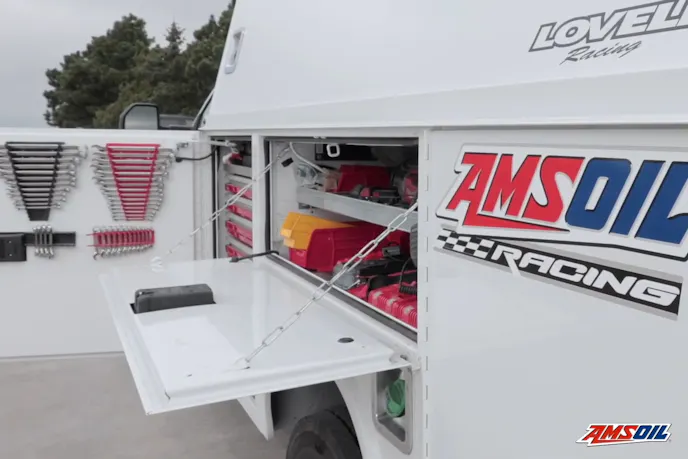
Lovell’s F-450 is less a conventional tow rig and more a carefully organized mobile race shop. Opening the exterior compartments reveals just how much equipment needs to travel with a serious off-road racing operation.
There are fire extinguishers for fueling operations, jack stands, recovery equipment for the chase truck itself, and a vise designed to mount in the receiver hitch. Drawers are filled with nuts, bolts, hardware, shop rags, and specialty equipment, while an inflatable work light and off-road jack are ready for repairs after dark.
One cabinet receives more attention than almost any other.
“It’s all our tools, so we’re not skimping here,” Lovell says. “We have all the basic hand tools that we’d have in the shop in these drawers. It’s definitely the most accessed cabinet.”
That distinction is important. When something breaks during a desert race, there may not be a parts store, repair shop, or even pavement anywhere nearby. Whatever the crew needs to diagnose and repair the problem has to arrive with them.
The truck also has a dedicated workbench area that serves as a catchall when repairs begin. Nearby is an onboard air compressor, a trail welder, extension cords, and other equipment necessary to make repairs far from civilization.
Then there’s fuel.
The F-450 carries an 80-gallon internal tank filled with race fuel, complete with its own dispensing nozzle. That gives the chase crew the ability to refuel a race vehicle wherever the course and race strategy demand rather than relying exclusively on established fuel stops.
The largest storage area is reserved for spare race-vehicle components. Instead of simply piling parts into the truck, Lovell’s team uses separate inventoried crates for its different race vehicles. The appropriate crates go into the truck before an event and come back out afterward, allowing the team to know what parts are onboard and where to find them when seconds matter.
Staying Connected In The Middle Of Nowhere
Modern communications have also changed what’s possible from a chase truck.
Lovell’s F-450 has a radio tucked inside one of its compartments along with upfitter switches controlling the truck’s Starlink system.
“Starlink, of course, is very important in off-road racing,” Lovell says. “It’s changed the whole game with ability to communicate.”
That connectivity becomes especially valuable in remote areas such as Baja, where traditional cellular coverage can disappear and race teams can be separated by enormous distances.
Additional lighting is controlled through the truck’s upfitter switches as well. A compact front-mounted off-road light can switch between amber and clear illumination, giving the crew additional visibility when navigating rough roads, washouts, and potholes after dark.
None of these features necessarily make the F-450 glamorous, but collectively they make it an indispensable piece of the racing operation.
Reliability Becomes Part Of The Race Strategy
All that equipment is useless if the truck carrying it doesn’t arrive.
“I got to be honest, one of my biggest fears during racing is having a chase truck go down 1,000 miles into Mexico,” Lovell says.
That concern explains why reliability receives so much attention. The F-450 isn’t merely towing the race truck to an event and parking. It can be loaded heavily, towing through mountain terrain, traveling thousands of highway miles, idling for extended periods, and pounding across deteriorated roads while carrying the equipment needed to keep the race vehicle alive.
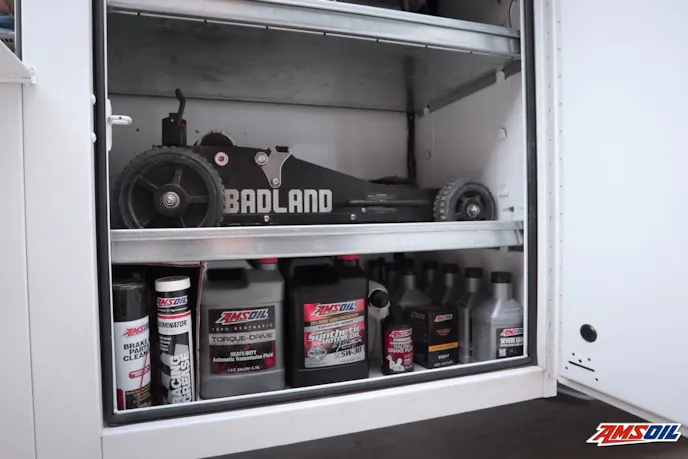
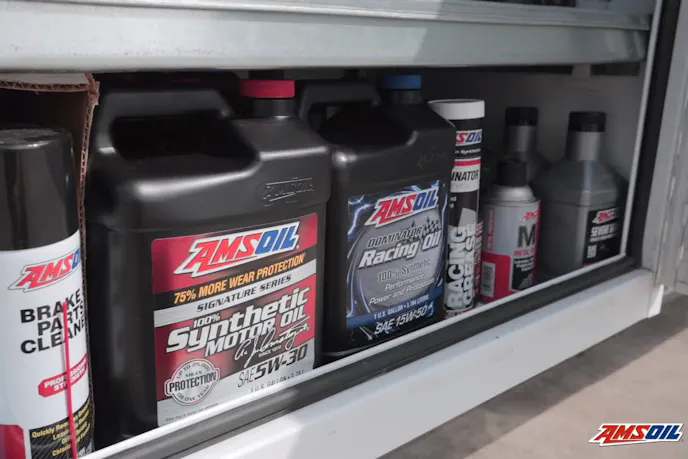
Those demands are also why Lovell’s team uses AMSOIL lubricants in the truck.
The F-450’s diesel engine runs AMSOIL Signature Series 5W-40 Synthetic Max-Duty Diesel Oil. For Lovell, the goal is straightforward: protect an engine that may encounter dramatically different operating conditions during the same racing trip.
“We’re depending on our chase truck to do all the work from the time that we leave the shop to when we get back,” Lovell says.
That can mean long highway pulls with a race trailer hooked behind it followed by hours spent operating in extreme desert temperatures.
“Whether it’s idling in the desert in 120-degree heat, towing a race trailer through the mountains, this is the backbone of our team and we can never have it go down.”
Protecting More Than The Engine
The engine isn’t the only component dealing with severe conditions.
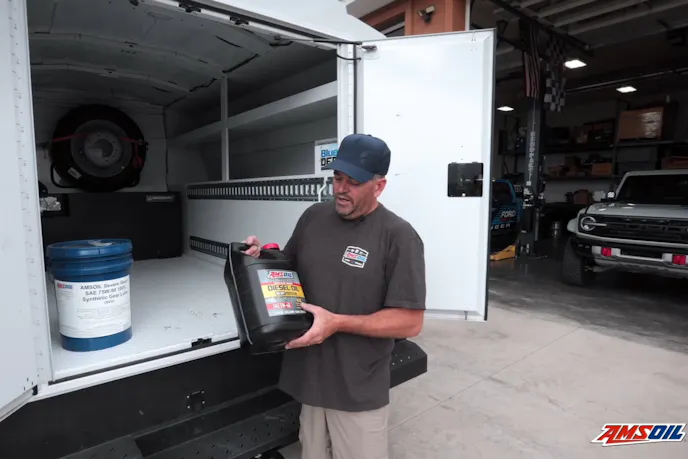
Lovell also runs AMSOIL Severe Gear 75W-90 Synthetic Gear Lube in the F-450. While differential lubricant may not receive the same attention as engine oil, the rear axle in a loaded chase truck can face its own demanding combination of heat, weight, speed, and shock loading.
“When we have these vehicles loaded, it puts a lot of heat in that rear ring and pinion hitting potholes down in Mexico,” Lovell explains.
That’s an especially challenging operating environment. The truck can transition from towing at highway speed to hammering across uneven surfaces while still carrying tools, fuel, spare parts, and recovery equipment. Every pothole and rough section sends additional loads through the axle assembly while the differential continues transferring the diesel engine’s torque to the ground.
For Lovell, using AMSOIL in both the engine and differential is less about adding another race-day variable and more about eliminating one.
“We need the best reliability,” he says. “It’s something we can’t worry about when we’re focused on racing the car. That means the best protection.”
The Truck That Makes Racing Possible
Purpose-built race vehicles will always get most of the attention, and understandably so. They’re faster, louder, and far more exciting to watch than a loaded F-450 traveling down the highway.
But desert racing requires an enormous support system behind the vehicle wearing the race number.
Lovell’s chase truck illustrates just how much goes into that effort. It transports the race vehicle, carries 80 gallons of race fuel, hauls tools and inventoried spare parts, provides welding and compressed-air capability, keeps the team connected, and gives the crew a mobile workshop wherever the race takes them.
And it has to perform that job over thousands of miles without becoming another problem the team needs to solve.
That makes the chase truck more than transportation. It’s the link between the race shop and the race course, and the piece of equipment tasked with keeping everything else moving.
As Lovell puts it, “This is the backbone of our team and we can never have it go down.”
You might also like
How One Bad Injector Nozzle Can Damage A Diesel Engine. And How Dynomite Diesel Aims To Prevent It.
Dynomite Diesel owner Lenny Read explains why injector nozzle flow, manufacturing, and quality control matter for diesel performance.