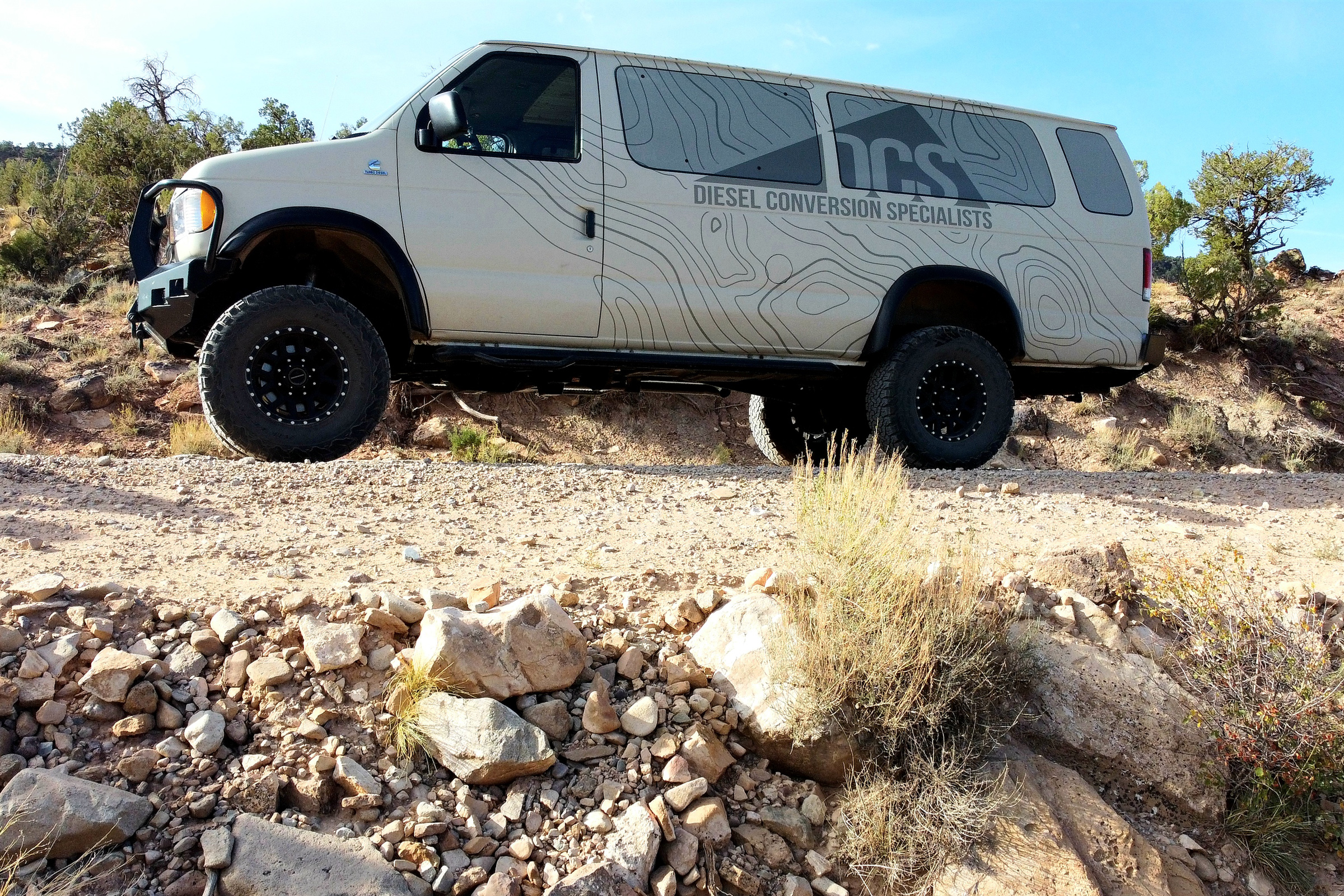
Adventure rigs tend to follow a predictable formula—lift kits, oversized tires, rooftop tents—but every so often a build comes along that rethinks the platform entirely. This 1997 Ford Econoline E-350 is one of those builds. At its core, it’s still the same boxy, utilitarian van that once hauled contractors and cargo. But beneath the doghouse now lives something far more purposeful: a 5.9-liter 12-valve Cummins diesel engine, swapped in with the help of Diesel Conversion Specialists (DCS) components.
The result is more than just a drivetrain upgrade. It’s a transformation that turns a humble van into a long-range, off-road-capable machine built for escaping the daily grind—and doing it reliably.
Why A Cummins Swap?
Let’s address the obvious question first: why go through the effort of swapping a Cummins into a van like this?
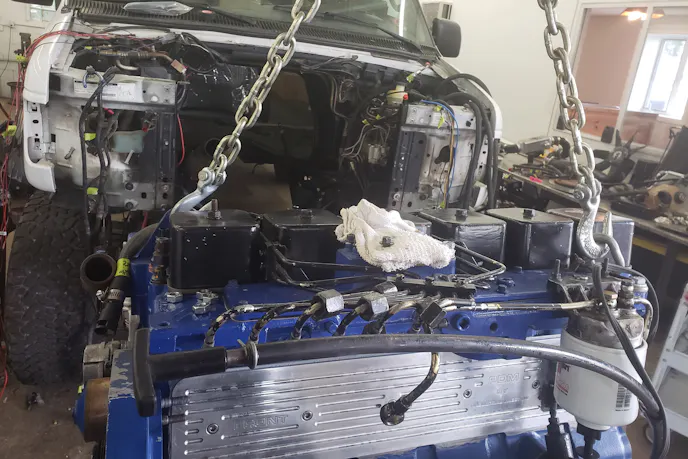
For many enthusiasts, the answer comes down to three things—durability, simplicity, and torque. The 12-valve Cummins, particularly the 1998-era 5.9-liter used here, has earned a near-mythical reputation. It’s mechanically injected, relatively simple to maintain, and capable of running for hundreds of thousands of miles with minimal fuss. Compared to gasoline engines or even later electronically controlled diesels, it represents a kind of analog reliability that’s increasingly rare.
There’s also the matter of torque. In a heavy platform like the E-350—especially one destined for 4×4 duty and overland travel—low-end grunt is everything. The Cummins delivers it in spades, making it ideal for crawling over obstacles, hauling gear, or simply cruising at highway speeds without strain.
But perhaps the most compelling reason is intangible. As the build sheet puts it, “there is a true sense of accomplishment when you start that diesel for the first time after a Cummins swap… knowing you are one step closer to escaping the day-to-day monotony.”
That sentiment captures the ethos behind builds like this better than any spec sheet ever could.
The Foundation: E-350 Meets 12-Valve
The base vehicle is a 1997 Ford E-350 Econoline, a platform known for its stout chassis and cavernous interior. Originally designed as a work van, it provides an ideal starting point for a rugged adventure build.
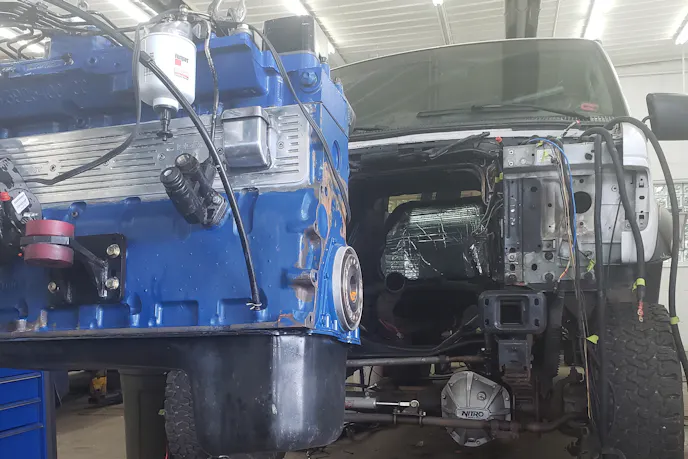
Under the hood now sits a 1998 Cummins 5.9-liter 12-valve engine, paired to an ATS-built Ford 4R100 automatic transmission. This pairing is significant. The 4R100, originally used behind Ford’s Power Stroke diesels, is a strong transmission in its own right—but integrating it with a Cummins requires careful engineering.
That’s where Diesel Conversion Specialists enters the picture.
The DCS Difference: Making It All Work
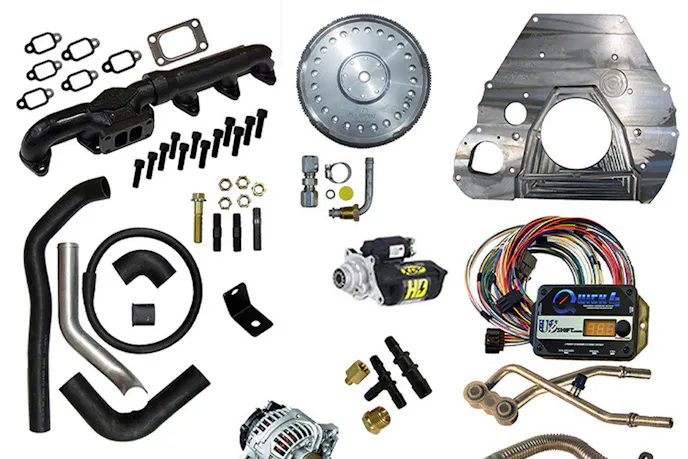
Engine swaps live or die by the details, and this build leans heavily on purpose-built DCS components to bridge the gap between Ford and Cummins engineering.
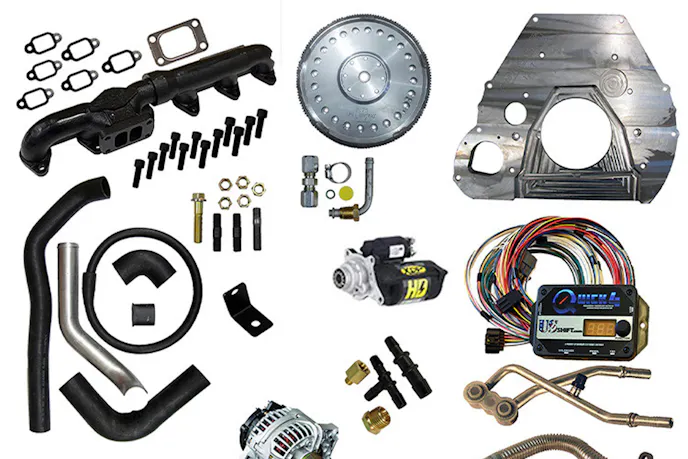
At the heart of the conversion is an adapter plate (SKU# 2360) that mates the Cummins engine to the Ford E4OD/4R100 transmission pattern. Without this, the swap simply wouldn’t be feasible. Complementing it is a custom SFI 29.3-certified flex plate (SKU# 2175), designed to handle the torque loads of the Cummins while interfacing cleanly with the Ford automatic.
Engine mounting is handled by dedicated DCS mounts (SKU# 2459), engineered specifically for installing a 1989–2002 Cummins into a 1992–2007 E-series van. This isn’t a universal, cut-and-weld solution—it’s a bolt-in approach that simplifies alignment and reduces guesswork.
On the exhaust side, a two-piece conversion-friendly manifold (SKU# 2147) and matching downpipe section (SKU# 1808) help route exhaust gases cleanly through the tight confines of the van’s engine bay. Supporting components like a heavy-duty gear reduction starter (SKU# 2692) and a throttle cable for the P-pump Cummins (SKU# 1585) round out the essentials.
For builders looking to go further, DCS also offers complementary pieces such as a stand-alone engine harness and a one-wire alternator—components that simplify wiring and charging system integration in a swap like this.
Taken together, these parts transform what could be a fabrication nightmare into a structured, repeatable process.
More Than One Trick: Who Is Diesel Conversion Specialists?
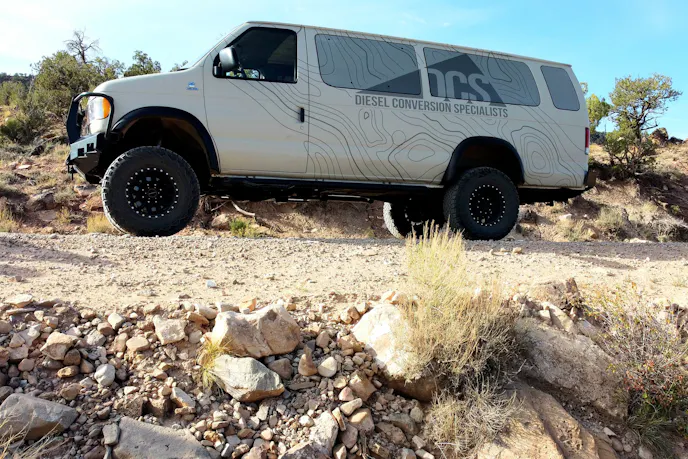
Behind builds like this is a company that has quietly become a cornerstone of the diesel swap world. Diesel Conversion Specialists (DCS) isn’t just a parts supplier—it’s a solutions provider focused on making complex engine swaps accessible to builders who demand OEM-like fit and function.
At its core, DCS specializes in bridging platforms that were never meant to work together. Their catalog is built around precision-engineered components—adapter plates, flex plates, engine mounts, wiring solutions, and accessory systems—that eliminate much of the guesswork traditionally associated with diesel conversions.
While this E-350 project highlights a Cummins-to-Ford pairing, that’s only part of the story. DCS supports a wide range of swaps, most notably installing Cummins 5.9-liter and 6.7-liter engines into Ford Super Duty trucks, older Ford pickups, and vans like the E-series. These conversions have become increasingly popular among enthusiasts looking to combine Ford chassis dynamics with Cummins reliability and torque.
Beyond Ford platforms, the broader diesel swap landscape that DCS caters to often includes cross-brand builds, Cummins swaps into GM platforms, TDI engines into Toyotas, and even industrial or off-road applications where durability is paramount. What separates DCS is its focus on making those swaps as close to bolt-in as possible.
The company’s approach reflects a deeper understanding of what builders actually need: not just parts, but systems that work together. A properly engineered adapter plate is only useful if the flex plate, starter engagement, transmission spacing, and mounting geometry are all accounted for. DCS builds its ecosystem around that reality.
Drivetrain And 4×4 Capability
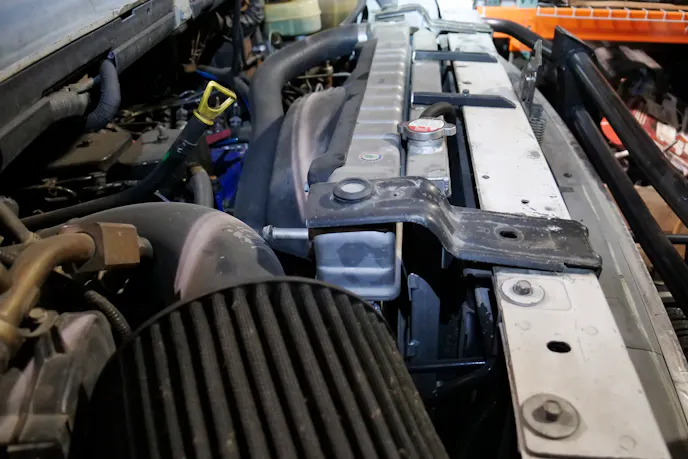
Of course, an adventure van isn’t just about the engine. This E-350 has been outfitted with a drivetrain capable of taking that Cummins torque well beyond paved roads.
A New Process NP271 transfer case handles power distribution, a proven unit known for its durability in heavy-duty applications. Front and rear axles are sourced from Ford Super Duty pickups, bringing increased strength and aftermarket support to the build.
The combination effectively turns the van into a 4×4 platform capable of tackling rough terrain while maintaining the payload and interior space that make the E-series so appealing.
Built For The Experience
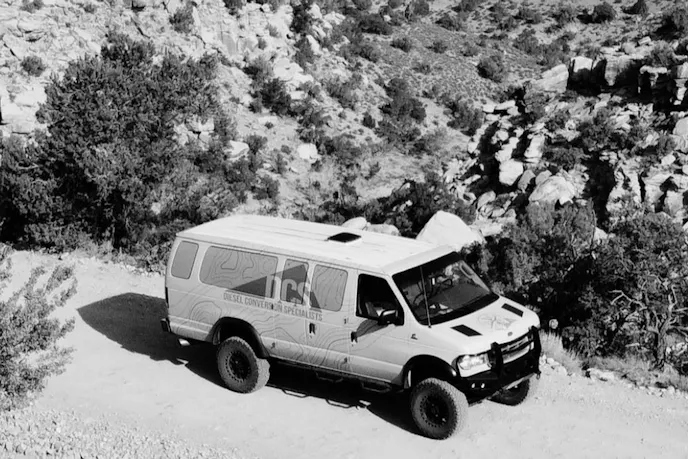
There’s a recurring theme throughout this build: it’s not just about capability—it’s about experience.
Even the choice of components reflects that mindset. The use of “weld-it-yourself” bumpers hints at a hands-on approach, one where the builder is deeply involved in every stage of the project. This isn’t a turnkey build; it’s a process, and that process is part of the reward.
The Cummins swap itself embodies this philosophy. It’s not the easiest route, nor the cheapest. But it offers something that modern vehicles often lack: a direct mechanical connection between driver and machine. No complex electronics, no black-box diagnostics—just fuel, air, and compression doing their thing.
The Bigger Picture
In many ways, this 1997 E-350 represents a broader trend in the enthusiast world. As factory vehicles become more complex and less serviceable, builders are looking backward—toward simpler, more robust platforms—and combining them with proven components to create something new.
A Cummins-swapped van sits right at that intersection. It blends the practicality of a full-size van with the durability of a legendary diesel engine and the capability of a 4×4 drivetrain. The result is a vehicle that can carry you, your gear, and your ambitions far beyond the pavement.
And maybe that’s the real point.
Because at the end of the day, builds like this aren’t just about horsepower or torque figures. They’re about possibility. About turning a once-ordinary work van into a machine that invites you to go further, stay longer, and explore more.
Or, as this build so perfectly suggests—about taking the first step toward escaping the monotony.
You might also like
7.3L Power Stroke Gets A 10R140 10-Speed Transmission Swap
See how US Shift and Performance Adapters swapped a modern Ford 10R140 10-speed automatic into a 7.3L Power Stroke Super Duty.