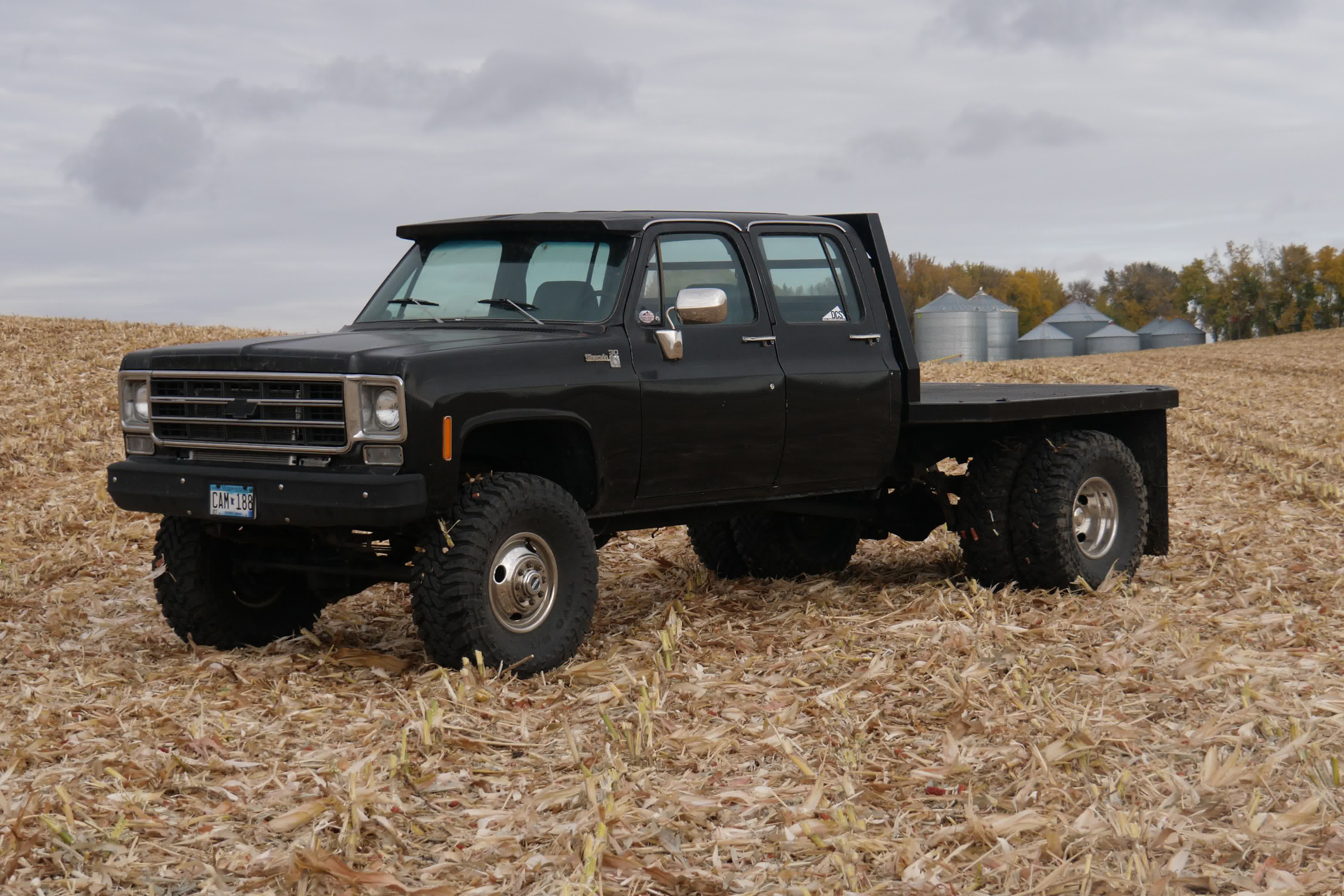
Every shop has a story about the one that came in on a trailer. For the team at Diesel Conversion Specialists, this 1977 Chevrolet is that story. It surfaced on Craigslist as somebody else’s unfinished Cummins conversion. The engine was in, sort of. It sat on solid mounts in the engine bay with the head off and the bottom end seized. The axles, wheels and tires were still under the truck, but the rest of the drivetrain sat on a pallet nearby. The interior was, in the crew’s word, “in shambles.” The truck was together enough to roll onto a trailer, and that was about all it had going for it.
It had more history than anyone at the auction-and-classifieds level would have guessed. The truck left the factory as a two-wheel-drive one-ton dually. Its original engine and transmission are lost to time. A crate next to the truck held a GM SM465 four-speed, but the tunnel and firewall told the DCS crew the truck had been born with an automatic. Somewhere along the line, somebody had big plans and ran out of steam.

Why Bother
Plenty of people would have parted it out. DCS saw something else. “I think most truck enthusiasts can agree that it is hard to see a Square Body in a disassembled state knowing its yearning to see the open road again,” the team says. “The fact that it was an attempted diesel swap tipped the scales in its favor of becoming a DCS vehicle.”
The plan came together fast. “The vision of the truck was all there upon picking it up. Nothing flashy but a head turner no less.” The real ambition was underneath. DCS wanted to try a drivetrain combination it had never seen anywhere else: a mechanical 12-valve Cummins, a GM 6L90E six-speed automatic and the classic gear-driven NP205 transfer case. “I really wanted to see how that setup would work out with a double overdrive.”
The truck rolled into the shop in early 2019. For roughly three years, it got worked on whenever there was a gap between customer builds. DCS handled the entire build in-house. The transmission tuning was the one big exception, and for that the team worked closely with Zero Gravity Performance, because, as DCS puts it, “marrying the 12 valve to the 6L90 is not common practice.”

The Case For Stock
The engine is a 1996 5.9-liter 12-valve Cummins with the Bosch P-pump, the combination diesel people still talk about the way hot rodders talk about the small-block Chevy. DCS has put plenty of them into Square Bodies over the years, and the team likes how well they fit. “The p-pump Cummins 12 valve is a good choice for the square body platform. They fit well in the engine bay with little modification.” This truck gave them a place to try some design changes, and as they put it, “What better way to accomplish that than with a unique combination of drivetrain components.”
What DCS didn’t do to the engine says more about the truck than anything it did. No fuel plate tricks, no injectors, no bigger turbo, no studs. “Some trucks are fun to build fast. This one was fun for different reasons,” the team says. “This engine is bone stock. Heck we even installed a muffler. No smoke and you could sneak in the driveway without waking the dog.”
That means the 12-valve makes what Cummins rated it for in 1996: 180 hp and 420 lb-ft of torque. For a shop that knows exactly how to turn a P-pump up, leaving it alone was a deliberate call, and it goes back to something one DCS builder learned long ago from a father and son who rebuilt small-block Chevy 350s. “Both would build fantastic engines. The son made fast engines, and the father made reliable ones. After spending enough time with both of them I came to the conclusion you do not typically get both in an engine build. Most settle for a happy medium.” On this truck, DCS sided with the father.

The Six-Speed Gamble
Ask a room full of diesel guys what goes behind a 12-valve and you’ll hear 47RH, NV4500, maybe a 4L80E or an Allison. You won’t hear 6L90E. That’s exactly why DCS picked it.
“That is a great question,” the team says when asked why. “The 6L90’s are readily available and are a relatively untapped market. They possess a double overdrive with a final drive ratio of .67:1. You can throw down a pretty penny for an Allison 6 speed to get a double overdrive but we wanted to see what other viable options are out there. We were on a quest for a reliable option that is more affordable for customers looking for better overdrive gearing for today’s highway speeds.”
Zero Gravity Performance built the transmission to its Stage 3 spec, the package ZGP recommended once DCS described the setup. DCS doesn’t claim to know ZGP’s internal recipe, but it knows why the transmission needed the help. “There is quite a bit of rotating mass and low-end torque to keep in check.”

Teaching An Old Engine New Tricks
The obvious problem is that the 6L90E was designed to take orders from an engine computer, and a P-pump 12-valve doesn’t have one. DCS boils the solution down to the basics. “All the transmission needs to know is what you want and when to change gears or lockup. You always need a TPS signal and that is how you tell it what to do. It bases when to do it either by monitoring RPMs or speed. This one bases when to shift and lockup off RPMs.”
The go-between is a PCS TCM2650 transmission controller, a unit built for 6L80E and 6L90E swaps that needs only a throttle-position signal and engine RPM. On this truck, both signals come from factory Dodge Cummins sensors, the throttle-position sensor and the tachometer pickup. The TCM2650 is calibrated to read those Dodge values, and it translates the old Cummins into terms the six-speed understands.

Bolting Rivals Together
Joining a Dodge engine to a GM transmission is DCS’s home turf, and the hardware is straight off the shop’s own shelf. The bellhousing bolts to a DCS 1989-2002 Cummins 12-valve and 24-valve to GM 4L60E, 4L80E and Allison adapter plate, SKU 1374. It pairs with the DCS Chevy/GM to Cummins flexplate, SKU 1327, an SFI 29.3-certified piece designed specifically for DCS GM adapter plates. Cranking duty falls to a starter from yet another rival camp: a Ford 6.4-liter unit that, in the team’s words, “wakes the sleeping 12 valve when called into service.” (DCS stocks a 6.4-liter-fitment XDP HD gear-reduction starter, SKU 2692 for this adapter plate.)
That makes the truck a Chevy with a Dodge engine, a Ford starter and a GM performance-car transmission. Somewhere, a brand-loyal forum moderator just felt a chill.

The NP205 Problem
Getting the 6L90E to talk to the NP205 was a fight of its own. The gear-driven GM transfer case is about as tough as they come, but it was never meant to sit behind this transmission, and the case had to be machined to accept a larger bearing and a different input shaft. “It was a task and you really must want the NP205 bolted to this transmission to commit to the job,” the team says. A kit from Advance Adapters made it a lot easier. It came with “the adapter, gears, bearing and instructions to get the job done.”


Borrowed Cooling, Homemade Bed
Cooling came from the same place as the engine. DCS pulled the whole Cummins cooling package from a 1995 Dodge donor, including the radiator, intercooler and intercooler piping, and fit it into the Chevy’s core support. According to the team, it “transfers well into the Chevy’s core support with some cutting and drilling but was not a daunting task if comparing it to a typical retrofit.” The fan shroud took the most fabrication. For anyone planning their own Square Body swap, DCS calls the Dodge cooling pack “a simple upgrade that will ensure proper cooling for your 12 valve.”
The flatbed didn’t come out of a catalog. “The fabrication of the flatbed was not a purchase and is made from a design idea, cutters and a welder. We find it’s just fun to make things.” It carries tie-downs and a recessed gooseneck ball, and a 40-gallon fuel tank is mounted at the rear. The fill port is built right into the bed. If a load ends up covering it, there’s a second fill neck hidden out of sight.
The truck rolls on stock Chevy dually wheels from the era, wrapped in Toyo Open Country M/T tires in LT385/70R16.


Ten Steps Ahead
Ask DCS which part of the build took the most engineering and you won’t get one answer. “Honestly, the whole build is heavy on fabrication and engineering. Looking back, it all felt the same. These one-off builds take a different plan of attack.”
The engine and transmission went in and out several times before they sat where DCS wanted them. After that came the harder job of getting parts that were never meant to meet to work together. “You must think 10 steps ahead and know how all the systems function. For example: You can’t just have A/C in the truck. You must know how the system works and what it needs to work properly. Then you must have the fabrication ability to install it where it is best suited so that it will not cause issues or failures.”
That mindset comes from years spent servicing and repairing heavy equipment for a dirt-work company. “It only takes one failed O-ring on an excavator to shut down an entire jobsite. So do your best to prevent failure and maximize reliability. These are the same reasons the truck has its stock Cummins engine with an improved 6L90E. We were not after more power. We were set on achieving reliability and an extra overdrive gear in a unique application. Mission accomplished!”

Uncharted Territory
The hardest part of the build had no textbook answer. “This build was challenging in that it is not common practice to use a 6L80E or 6L90E in a diesel application,” DCS explains. The team points to GM’s Express vans with the 6.6-liter Duramax as the closest example, but says that engine “is a different beast in its usable RPM range when compared to a stock Dodge Cummins 12 valve. We really had nothing to compare it to, so knowing what normal operation should be was hard to define.”
So how do you know when you’ve got it right? “You know you’ve solved the problem if it doesn’t leave you on the side of the road. Haha.”

Behind The Wheel
By that standard, the problem is solved. The truck has roughly 15,000 miles on it, all casual road trips with no heavy towing or off-roading. It isn’t pushed hard. It goes to shows and down country roads, and that’s the whole point.
On the road it surprises people. “Handling is surprisingly more pleasant than one would expect. Truck drives down the road true and stays in its own lane without too much convincing, which is great with the wide wheelbase.” The drivetrain is the real story, though. The 12-valve stays low in the rev range between shifts, and the six-speed changes gears with a smoothness nobody expects from this kind of build. “You can cycle through the gear and stay under 2000 rpm all the way up to 70 mph.”
“It is the exact opposite of an old 4-53 Detroit 2-stroke diesel experience,” the team says, describing a truck that would rather putter along than scream. “It lives its best life down back country road just chugging along counting deer with an arm out the window. The added ground clearance allows for a bit of a bird’s-eye view even when the corn is high. Feels and sounds like driving an old IH 2096 tractor.”

Lessons From The Road
Fifteen thousand miles have turned up almost nothing. A steering knuckle loosened at around 5,000 miles, and the team is already eyeing an upgrade to suit the oversized tires. “There are some cool options out there for an interlocking knuckle that might be better suited for the build and neat to try. These projects are never done! Haha.”
The best story from the truck’s life on the road is about the driver, not the hardware. One spring, a DCS builder took the truck out of winter storage to drive his oldest son to an event and forgot to reset one of the Bussmann circuit breakers. The truck drove fine until he leaned on the throttle. Then it flared and the transmission dropped into limp mode. “There was instant disappointment in the passenger seat,” he remembers. He used it as a lesson, reminding his son “how unique a setup the truck is and that with that uniqueness will come unexpected issues that we can learn from.” The fix was easy. “Connected the circuit and we were fully operational again.”

If They Did It Again
Would DCS build it differently today? Not much, at least for what this truck was meant to do and the R&D it was built to answer. Daydreaming is another matter. A manual with deep granny gears, like a ZF S6-650, would turn it into a recovery rig. In the team’s words, they’d “take it to the local mud holes and pull the wading distressed swamp hoppers back to solid ground with a grin.”
The bigger takeaway is how good the 6L90E and 12-valve feel together. “The 6L90 paired with the 12 valve has very smooth shifts that are not characteristic of this type of build. I would ideally put this engine and transmission combination in a dropped 2wd dually of the same era to showcase the smooth and low RPM shifts the combination has.”
That would bring this drivetrain back to a two-wheel-drive dually, the same layout this 1977 Chevy had when it left the factory. “That is all part of the learning process,” DCS says, “as well as a fun project for a later day.”
You might also like
Platinum With Calluses: ARB Outfits The 2027 Ford F-250 Super Duty For Dusty Work
ARB’s 2027 Ford F-250 Platinum build pairs the new Old Man Emu MT64-R suspension with Summit HD armor, an alloy canopy and onboard air.