
Oil analysis has long been one of the most powerful diagnostic tools available to diesel owners, offering a window into engine health that no scan tool or seat-of-the-pants impression can match. Hot Shot’s Secret offers a used oil analysis service designed to give diesel owners and performance enthusiasts a deeper look inside their engine—without turning a wrench. Instead of relying solely on mileage-based oil changes, this service uses lab testing to evaluate both oil condition and overall engine health.
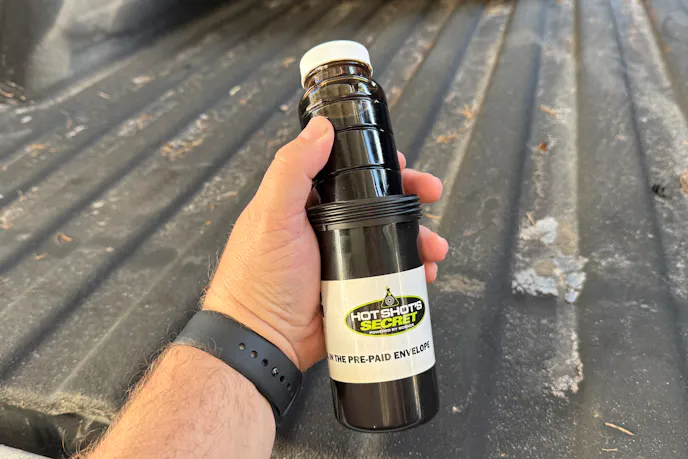
The process is straightforward. You purchase a test kit, collect a small sample of used engine oil, and send it to a lab. From there, the oil is analyzed for key indicators like viscosity, oxidation, contamination, and wear metals. These data points help reveal how well the oil is holding up and whether internal components—like bearings, cylinders, or valvetrain parts—are experiencing abnormal wear.
One of the biggest advantages of Hot Shot’s Secret oil analysis is its predictive capability. By identifying issues such as fuel dilution, coolant intrusion, or excessive soot early, owners can address problems before they lead to costly failures. The service also provides recommendations on whether to extend or shorten oil change intervals based on actual conditions, not guesswork.
In our case, a sample pulled from a 2005 Ford F-350 equipped with the 6.0-liter Power Stroke, showing approximately 275,000 miles on the engine and 10,000 miles on the oil, tells a story that is both reassuring and cautionary at the same time.
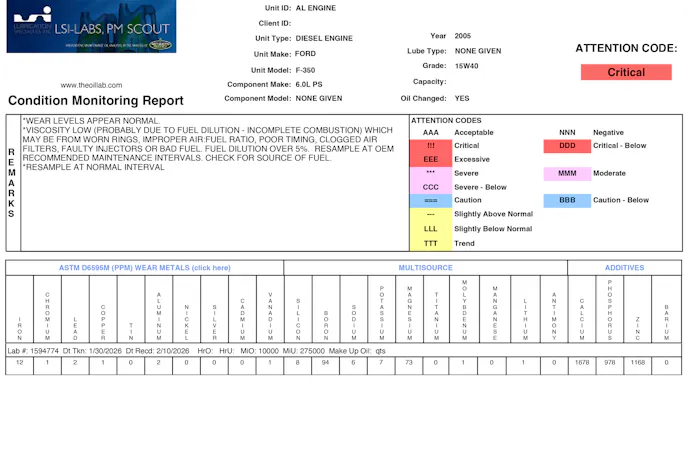
At first glance, the report raises eyebrows with a bold “CRITICAL” attention code. But as with any good analysis, the headline doesn’t tell the whole story. Digging into the data reveals a far more nuanced—and ultimately valuable—diagnosis.
A Healthy Engine Hiding Behind A Red Flag
Despite the alarming top-line designation, the internal condition of the engine appears remarkably stable. The lab notes clearly state that “wear levels appear normal”, a conclusion supported by the wear metal data. Iron, the primary indicator of cylinder and rotating assembly wear, measures just 12 ppm, while copper and lead—key indicators of bearing health—come in at 1 ppm and 2 ppm respectively. For an engine with over a quarter-million miles, those numbers are impressive.
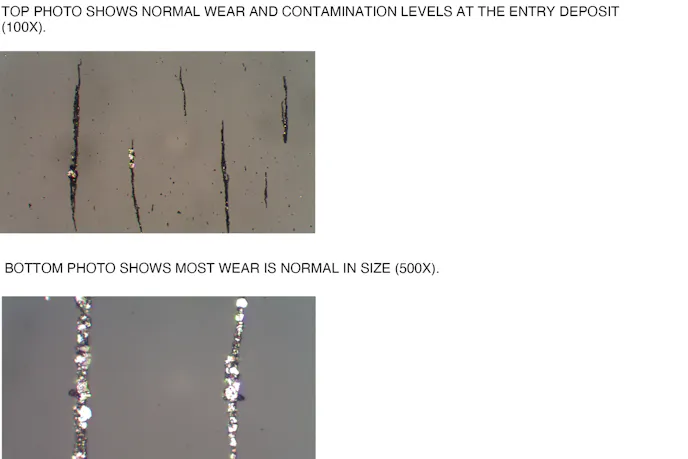
Further confirmation comes from advanced particle analysis included in the report. The lab observed that “wear and contamination levels appear normal. Only traces of severe wear were found”. Microscopic evaluation shows predominantly normal rubbing wear, with no meaningful presence of cutting or fatigue particles. In practical terms, the rotating assembly, valvetrain, and bearings are not currently experiencing abnormal stress.
This is a critical distinction. Too often, a “critical” label is interpreted as impending failure. In this case, the engine itself is not the problem.
The Real Problem: Fuel Dilution And Its Consequences
If the hard parts are holding up, the issue lies in the oil. The report points directly to the culprit: “viscosity low (probably due to fuel dilution – incomplete combustion)… fuel dilution over 5%”.
Measured viscosity at operating temperature comes in at 9.8 cSt at 100°C. For a 15W-40 lubricant, this is significantly below spec, effectively thinning the oil into a lower-viscosity range. That loss of thickness compromises the oil’s ability to maintain a protective film between critical components.
Fuel dilution at this level is more than a statistical anomaly. Diesel fuel acts as a solvent inside the crankcase, reducing lubricity and washing protective additives away from metal surfaces. While wear metals remain normal for now, the conditions for accelerated wear are clearly in place.
Oil Condition vs. Oil Contamination
Interestingly, the oil itself has not reached the end of its chemical life. The Total Base Number (TBN)—a measure of the oil’s remaining additive reserve—registers at 4.44, indicating that the oil still retains the ability to neutralize acids and resist degradation under normal circumstances.
Contamination indicators further support this. Soot levels remain low at 0.17, while oxidation is measured at 18.81, both well within acceptable ranges for a diesel engine at this interval. This reinforces a key takeaway: the oil did not fail due to overuse—it was compromised by external contamination.
That distinction matters, especially for enthusiasts exploring extended drain intervals or advanced lubrication strategies. Even the best oil cannot perform if it is being diluted.
Tracing The Source: Where The Fuel Is Coming From
The lab outlines several possible causes, noting that fuel dilution may stem from “worn rings, improper air:fuel ratio, poor timing, clogged air filters, faulty injectors or bad fuel”. For the 6.0-liter Power Stroke platform, real-world experience narrows the likely culprits.
Injector-related issues are the most common. A leaking injector or poor spray pattern can allow raw fuel to wash down cylinder walls and enter the crankcase. Operating conditions also play a role. Extended idling or frequent short trips can prevent the engine from reaching temperatures high enough to burn off excess fuel.
Less commonly, worn rings or compression loss may contribute, though the absence of elevated wear metals suggests that significant mechanical wear is not yet present.
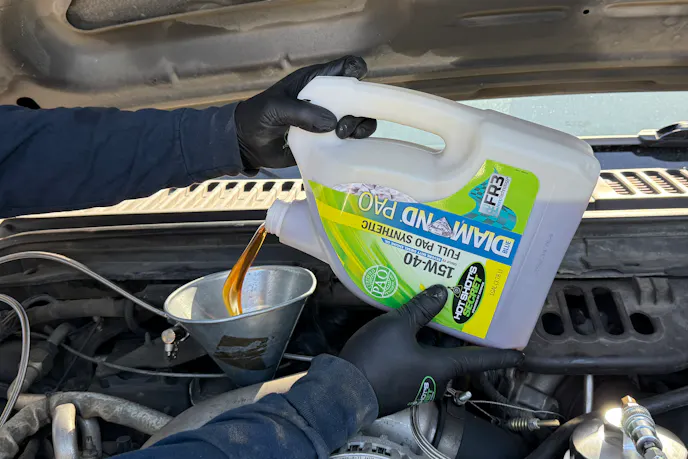
Blue Diamond 15W-40: A Fresh Fill
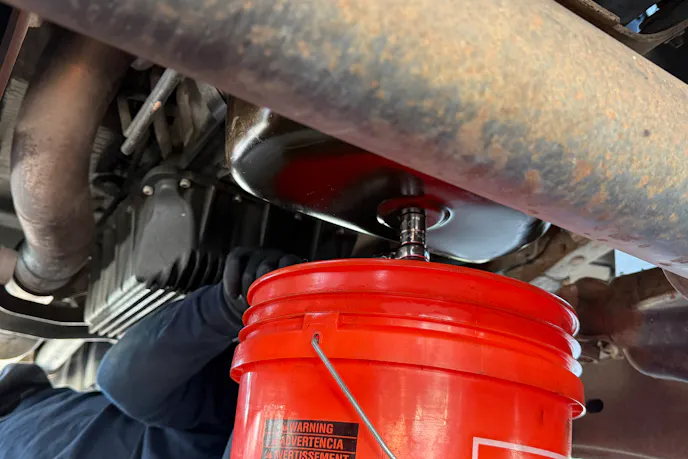
After dumping the old engine oil and pulling our sample for testing, we needed 15 quarts of quality lubricant to top off our workhorse. Hot Shot’s Secret Blue Diamond 15W-40 is a premium full synthetic diesel engine oil built around a true 100-percent PAO (Group IV/V) base stock, which already puts it a tier above conventional and most “synthetic blend” oils. Because PAO requires fewer viscosity improvers, the formula can be loaded with more performance additives, helping the oil stay cleaner longer and maintain stability under heat and load.
What really sets Blue Diamond apart is its FR3 Nano Lubricant Technology. This additive works at a microscopic level, filling surface imperfections in metal components to reduce friction and wear. The result is less metal-to-metal contact, lower operating temps, and improved efficiency—key benefits for hard-working diesel platforms like the 6.0-liter Power Stroke.
It also carries a modern API CK-4 additive package, meaning strong detergency, soot control, and oxidation resistance. Compared to older CJ-4 oils, it handles soot significantly better and can reduce wear by a large margin, which is critical in high-mileage engines that already have internal wear and carbon buildup.
For older or high-mileage Power Stroke engines, this oil is a solid choice because it helps reduce oil consumption, protect injectors and turbo components, and extend drain intervals. The enhanced film strength and cleaning ability can keep aging internals alive longer while maintaining performance and reliability.
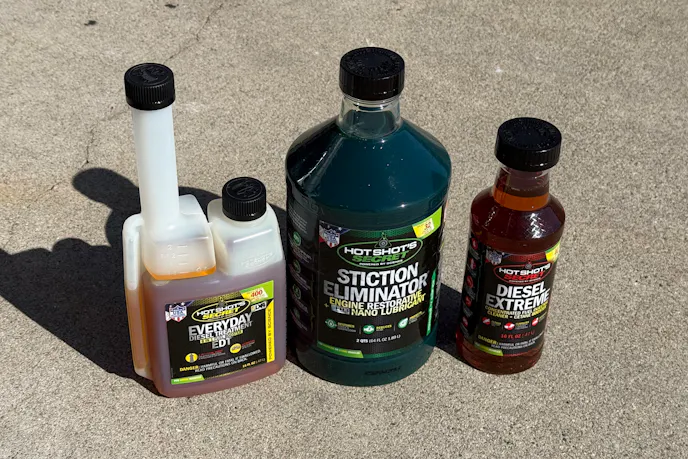
The Additive Strategy
Because we want this engine to last another quarter-million miles, we’ve adopted a robust fuel and oil additive strategy. Hot Shot’s Secret “Bulletproof Your Powerstroke” bundle is designed as a complete system approach to restoring and maintaining diesel performance—especially for engines prone to injector issues like the 6.0-liter and 6.4-liter Power Stroke. Rather than relying on a single additive, this kit combines three targeted treatments that work together on both the oil and fuel sides.
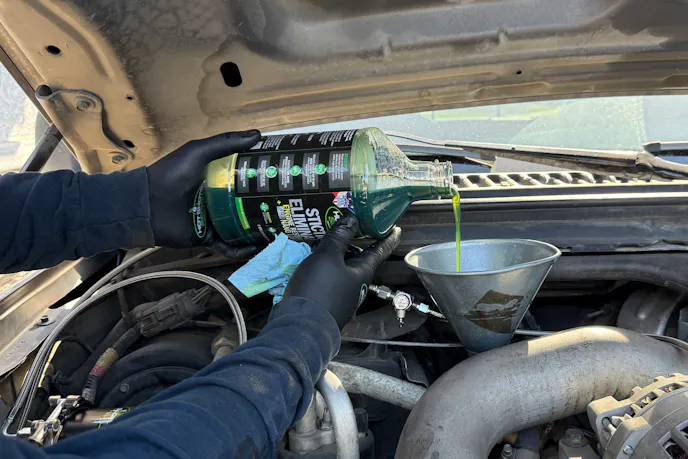
At the core is Stiction Eliminator, an oil additive formulated to clean internal injector components and free up sticky spool valves. This helps resolve rough cold starts, poor idle, and throttle hesitation—common symptoms of stiction in HEUI systems.
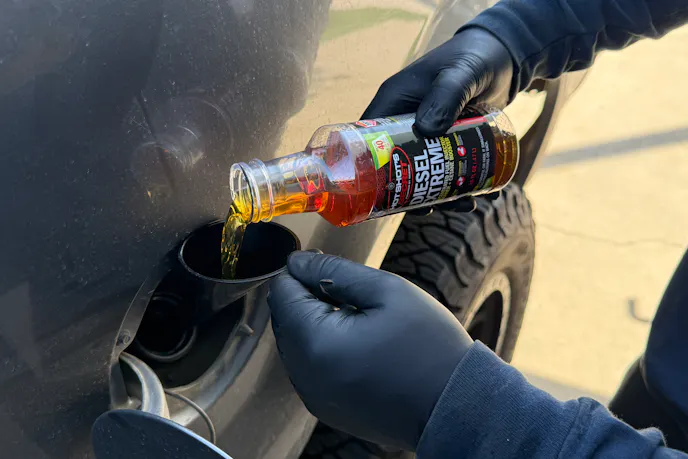
On the fuel side, Diesel Extreme acts as a deep-cleaning solution. It removes injector deposits, boosts cetane, and improves combustion efficiency. It’s essentially a reset for the fuel system, typically run through one or two tanks.
Rounding out the package is Everyday Diesel Treatment (EDT), a maintenance additive used at each fill-up. It enhances lubricity—critical with modern ultra-low sulfur diesel—and helps keep injectors clean over time.
From a technical standpoint, additives designed to enhance combustion efficiency and injector cleanliness can play a meaningful role in reducing unburned fuel entering the crankcase. Likewise, friction modifiers and anti-wear agents can help maintain protective film strength, even when oil viscosity begins to drop.
Together, these three products form a restore-and-maintain strategy aimed at improving drivability, fuel economy, and long-term reliability. While it won’t replace mechanical upgrades, this bundle offers a practical way to address some of the most common Power Stroke performance issues.
Why Timing Matters: Catching the Problem Early
What makes this oil analysis particularly valuable is when it was captured. The engine is not yet showing signs of distress, even though the oil has been compromised. This is the ideal window for corrective action.
Fuel dilution is often described as a “silent killer” in diesel engines. It rarely produces immediate symptoms, instead gradually degrading oil performance until wear accelerates. By identifying the issue before wear metals begin to climb, this analysis provides a clear opportunity to intervene.
The Path Forward
While the lab recommends resampling at normal intervals, a more proactive approach is warranted. Changing the oil immediately, as we did, would restore proper viscosity and lubrication, eliminating the immediate risk posed by fuel dilution.
From there, a shortened sampling interval—typically between 3,000 and 5,000 miles—can help determine whether the issue is persistent. If fuel dilution remains elevated, attention should shift to injector performance and overall fueling strategy.
At the same time, continued use of a high-quality oil such as Blue Diamond, combined with targeted additives, may help stabilize operating conditions. However, these measures should complement, not replace, mechanical diagnostics.

Final Analysis: A Best-Case Warning
In many respects, this is the best kind of “critical” report an owner can receive. The engine itself remains in good health, with wear patterns and metal concentrations that reflect a well-maintained, high-mileage diesel. The problem lies not in what has already failed, but in what could fail if current conditions persist.
The data paints a clear picture. A strong-running 6.0-liter Power Stroke, supported by modern oil and additive technology, has developed a fuel dilution issue significant enough to compromise lubrication. Addressing that issue now preserves the integrity of the engine and prevents a manageable concern from becoming a costly repair.
Oil analysis does more than diagnose problems—it provides foresight. In this case, it has done exactly that.
You might also like
Is Your Diesel Running Dirty? Cataclean May Be The Answer
Discover how Holley's Cataclean Diesel helps reduce carbon buildup, clean DPFs, and maintain diesel performance and emissions efficiency.