By the time a set of diesel injectors lands on a test bench, sometimes the most important discovery has nothing to do with whether the injectors themselves can be rebuilt.
That was the situation Dynomite Diesel Products owner Lenny Reed found himself in after a customer sent in a set of performance injectors for testing. At first glance, the injectors appeared to be in reasonably good condition. A closer examination of the nozzles, however, revealed two problems. One nozzle flowed substantially more than the other five, and there were signs that one cylinder in the engine may have already suffered significant damage.
Reed found aluminum deposited on the outside of one nozzle, along with evidence that something had physically struck its tip. His assessment was straightforward: the engine likely already had a damaged cylinder.
“When the EGT gets really high, piston starts to melt,” Read explained, noting that molten aluminum can end up on the face of the injector nozzle or elsewhere around it. After inspecting the affected nozzle more closely, he found multiple aluminum deposits and impact damage that he suspected could have come from a piston ring or other material inside the cylinder.
That discovery was important for another reason. If the customer simply installed a fresh set of injectors without addressing the underlying engine problem, the new parts could quickly become collateral damage.
“This thing’s already got a hurt hole,” Reed said. His concern was that the customer could install the replacement injectors, suffer an engine failure shortly afterward, and understandably assume the new injectors were responsible.
But the evidence of engine damage wasn’t the only interesting thing Reed found.
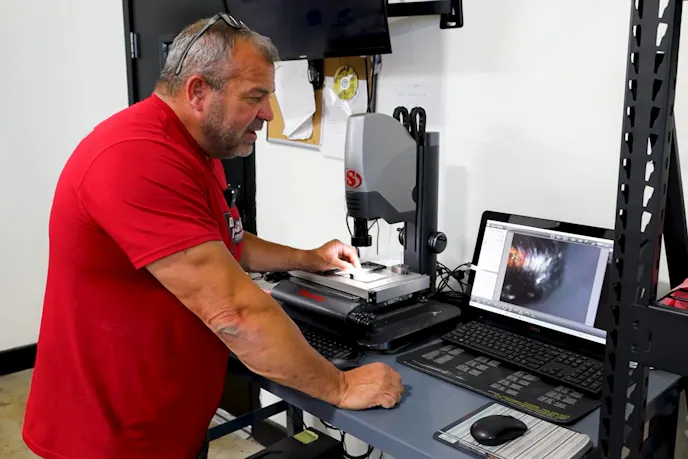
Six Nozzles That Weren’t Really A Matched Set
According to Reed, the nozzles had been extrude honed, but their flow measurements showed a significant discrepancy.
Five flowed approximately 21 to 22 liters of air per minute. The sixth flowed 29 liters per minute. Reed characterized the five smaller nozzles as being roughly comparable to Dynomite’s 50-horsepower offering, while the outlier represented what he described as a particularly strong 90-horsepower nozzle.
In other words, five cylinders were being fed by relatively similar nozzles while one cylinder had substantially more nozzle capacity.
Reed measured the exterior hole dimensions at approximately 0.0091 and 0.0092 inch. That’s a difference of only one ten-thousandth of an inch, yet he said the measured flow difference could represent roughly 15 percent versus 45 percent over stock. At peak rail pressures of 22,000 to 23,000 psi, that disparity becomes particularly significant.
It’s also why Reed argues that simply describing performance injector nozzles by hole diameter doesn’t tell the complete story.
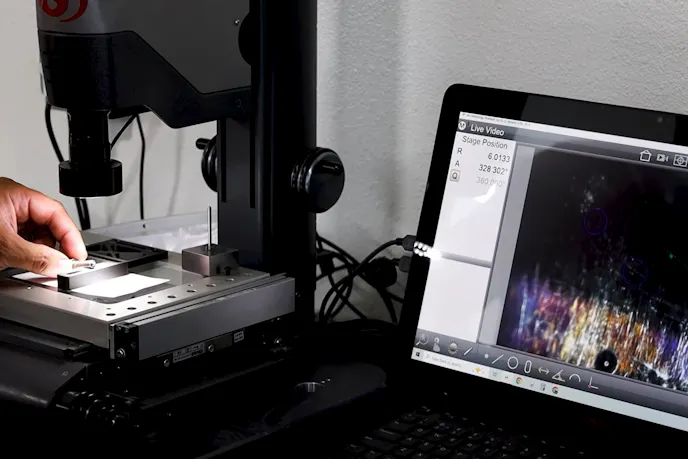
Hole Size Doesn’t Equal Nozzle Flow
It’s tempting to think of an injector nozzle as a collection of precisely sized holes. Make the holes larger and more fuel flows through them. While that’s directionally true, Reed’s explanation illustrates why nozzle development is far more complicated.
Two holes with nearly identical outlet diameters can behave very differently depending on their internal geometry.
Reed demonstrated this with an EDM-only nozzle. Electrical discharge machining, or EDM, can establish the basic hole, but the resulting internal entrance can contain a sharp 90-degree edge. As high-pressure fuel approaches that edge, Reed explained, turbulence and a low-pressure region can develop.
That means the entire apparent diameter of the hole isn’t necessarily being used efficiently.
Reed offered a theoretical example of a 0.0105-inch nozzle hole that might initially deliver around 305 cubic millimeters on the test bench. After modifying the internal geometry — without changing the hole’s outside dimension — he said the same nozzle could potentially move around 475 cubic millimeters.
“Again, this is why we don’t talk in hole size,” Reed said. “We’re talking about the efficiency of the hole and how effective that fluid can flow through that hole.”
That distinction becomes increasingly important as common-rail pressures climb. The goal isn’t merely creating a bigger opening. It’s controlling how fuel enters, travels through, and exits that opening.
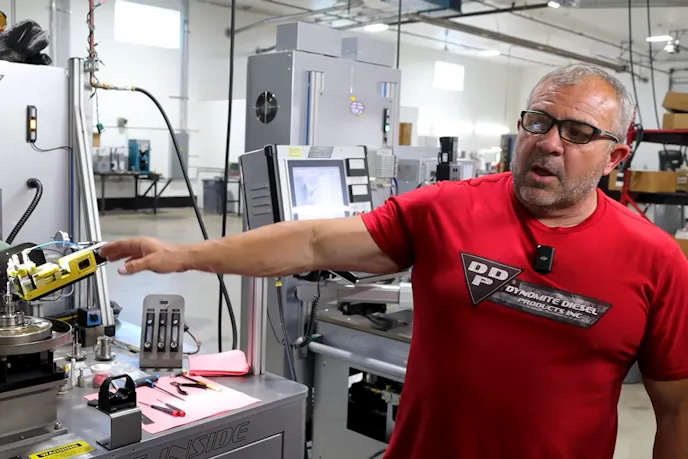
EDM Is Only The Beginning
Dynomite’s process starts by using EDM and a selected wire diameter to establish the nozzle holes. Importantly, Reed says the wire used for a particular batch remains with that job until the nozzle set is complete.
From there, the nozzle can move into abrasive finishing.
One method is extrude honing. Reed describes the abrasive media as having a consistency similar to Silly Putty or Play-Doh. A cutting agent is suspended within the material, and different media formulations and abrasive grits are used depending upon the size and type of hole being processed.
But simply extrude honing a nozzle isn’t necessarily the answer.
Reed explained that extrude honing removes more material from the passage and can significantly alter its shape. Done excessively, it can shorten the effective straight portion of the nozzle hole.
His analogy is a rifle barrel.
A longer, properly shaped passage helps maintain the direction of the fuel leaving the nozzle. Remove too much of that controlled passage and, in Reed’s words, it begins behaving more like a sawed-off shotgun. The spray can lose some of its intended directionality.
That’s especially consequential because injector spray angle needs to complement piston-bowl geometry. Reed used a 146-degree piston as an example: if excessive material removal compromises the nozzle’s ability to maintain its intended spray direction, fuel may no longer be aimed at the piston bowl as intended.
That potentially changes combustion in ways that a simple nozzle-hole measurement can’t reveal.
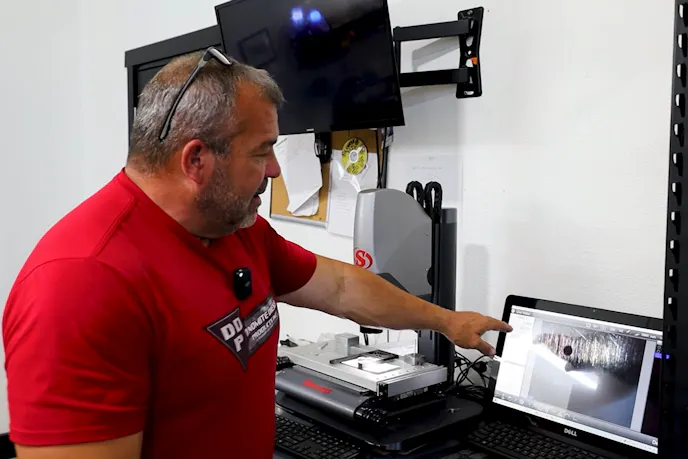
AFM, Extrude Hone, Or Both?
Dynomite doesn’t rely on one finishing method for every application.
Reed discussed both extrude honing and AFM, or abrasive flow machining, as tools for developing the desired internal nozzle geometry. His preference is to retain a longer, controlled passage and create the appropriate radius at the inlet without unnecessarily removing material elsewhere.
There are limitations, however.
On particularly large nozzle holes, Reed said AFM alone may not remove enough material to achieve the required result. In those applications Dynomite may use extrude honing, while some high-output mechanical sled-pulling applications receive a combination of the two processes.
The point isn’t that one method is universally superior. It’s that the manufacturing process should be selected around the nozzle’s intended geometry and flow requirements rather than simply enlarging holes until they reach a nominal dimension.
One example Reed showed during the shop walkthrough was a six-hole nozzle using 0.0112-inch EDM wire, extrude honed to a target of 72 liters per minute and retaining a stock 146-degree angle. He also noted that a QSB 6.7 application could instead use a 126-degree configuration to better match that engine’s piston.
It’s a small detail that illustrates a much larger point: nozzle design isn’t just about delivering more fuel. The fuel also has to be delivered in the correct manner and direction.
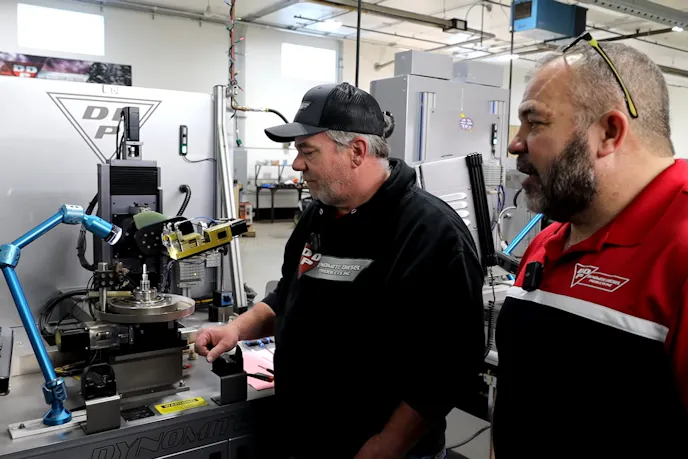
Traceability Matters More Than You Might Think
The mismatched injector set also highlighted a less glamorous but equally important part of Dynomite’s manufacturing process: recordkeeping.
As nozzles move through the company’s EDM and finishing operations, Reed says the production information travels with them. The EDM wire diameter is recorded along with the AFM recipe, and the parts then move to a laser station where identifying information is permanently applied.
That means a nozzle can theoretically be identified months or even years later.
Reed said this system is designed to prevent exactly the sort of situation he appeared to find with the customer’s injectors: one significantly larger nozzle mixed into a set of five smaller ones.
“There’s nothing to identify this nozzle from the rest of them,” Reed said of the competitor’s parts.
Dynomite’s process instead records information as the nozzles move from EDM through abrasive finishing and ultimately laser marking. According to Reed, that allows the company to identify what was done to a nozzle “a month or 6 months or 2 years or 10 years down the road.”
For a matched performance injector set, that’s more than manufacturing bureaucracy. It provides another layer of quality control.
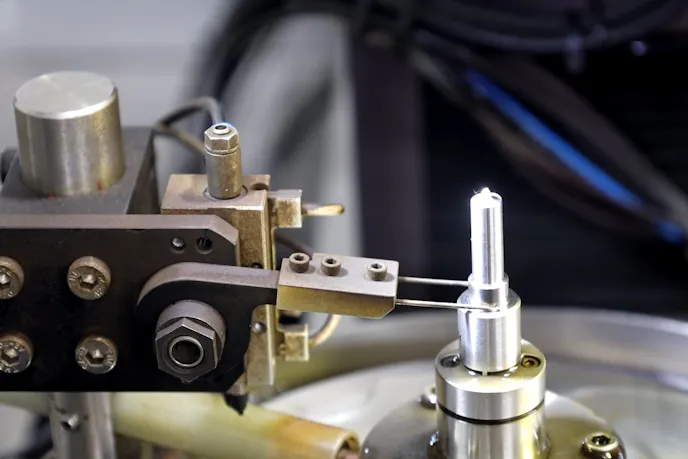
The Real Lesson Is Inside The Nozzle
There are actually two cautionary tales contained in Reed’s inspection.
The first concerns the engine itself. Aluminum on an injector nozzle isn’t something to ignore, and in this case Reed believed the evidence showed that one cylinder had already suffered damage severe enough that the engine needed attention before another set of injectors went into it.
The second concerns how performance injector nozzles are evaluated.
Hole diameter alone doesn’t tell you how much a nozzle flows. Likewise, simply knowing that a nozzle has been extrude honed doesn’t tell you whether its internal geometry is correct, whether its spray characteristics have been preserved, or whether all six nozzles actually match.
That’s where EDM dimensions, abrasive finishing, flow testing, spray angle, piston compatibility, and production traceability all become pieces of the same puzzle.
The competitor’s set provided a particularly dramatic example. Five nozzles were relatively close together while one flowed considerably more. Worse yet, the odd nozzle happened to come out of a cylinder that showed signs of existing mechanical distress.
Reed ultimately planned to make an uncomfortable phone call to the customer and explain that the engine appeared to already be hurt.
For diesel enthusiasts chasing more power, that’s probably the most important takeaway from the entire demonstration. An injector nozzle may be tiny, but what happens inside those microscopic passages — and how consistently they’re manufactured — can have very large consequences once rail pressure climbs into the tens of thousands of psi.
You might also like
Why Ford Might Skip The 8.0-Liter Power Stroke Diesel For A Hybrid
Ford's 2027 Super Duty order guide puts 8.0-Liter Power Stroke Diesel rumors to rest. A 7.3L gas hybrid makes far more sense for 2028.