There’s no denying the reputation of Ford’s legendary 7.3-liter Power Stroke diesel. Known for its durability, reliability, and impressive longevity, the engine remains a favorite among diesel enthusiasts more than two decades after production ended. However, while the engine has aged gracefully, the four-speed automatic transmission commonly found behind it hasn’t kept pace with modern technology.
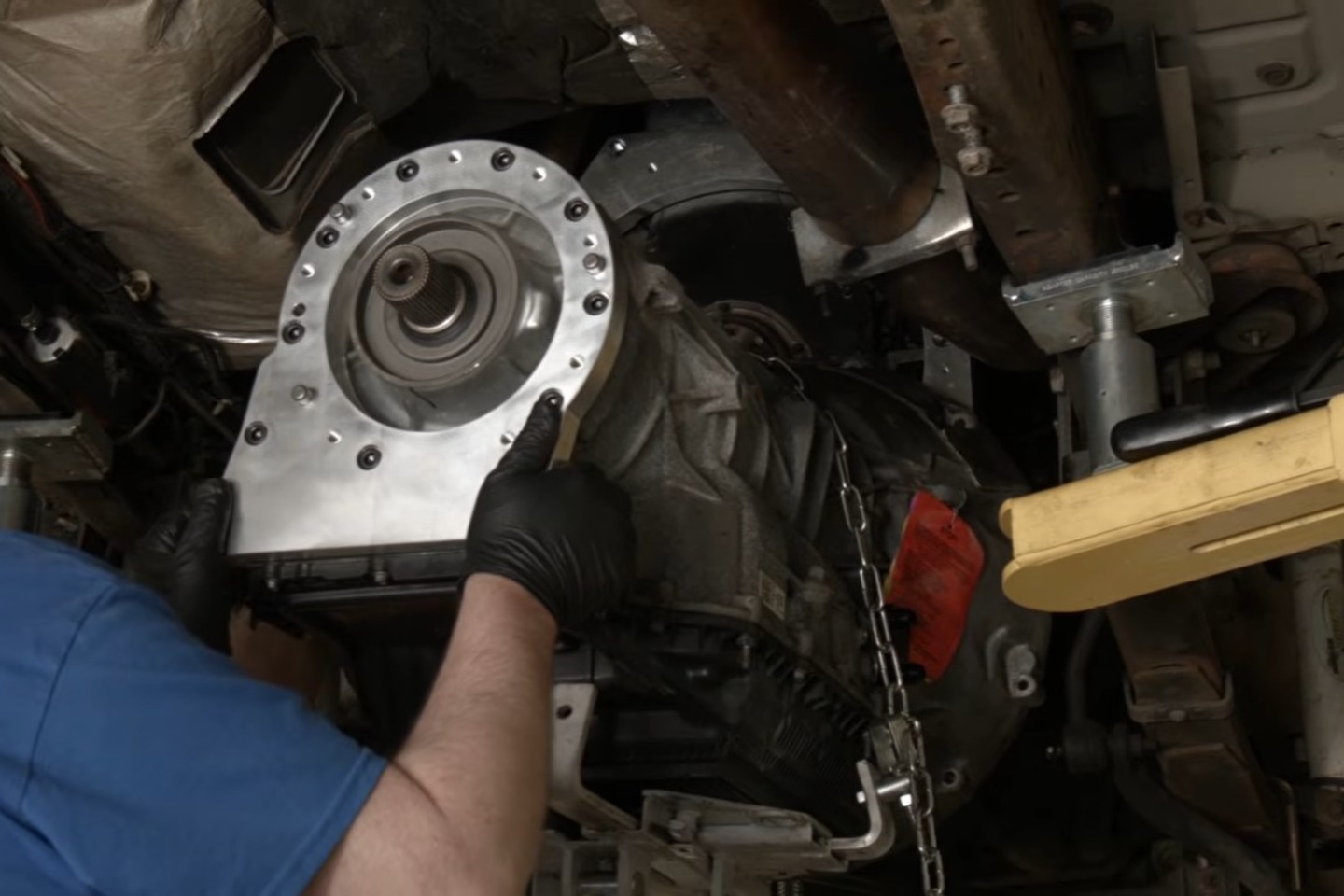
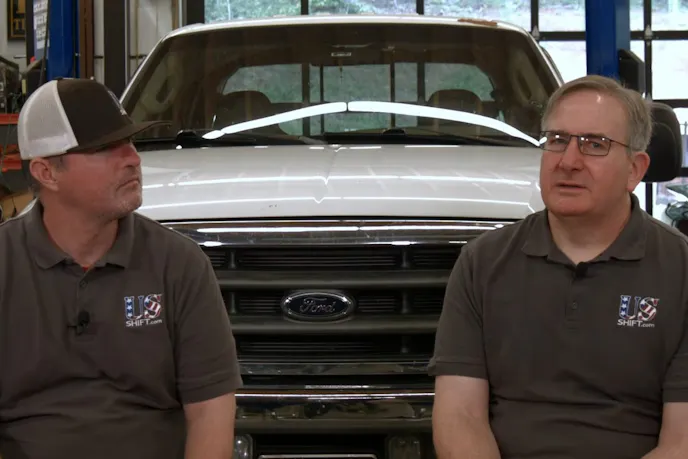
That’s exactly what the team at US Shift, a division of Baumann Electronic Controls, set out to address. Working alongside Performance Adapters, the company recently completed a remarkable drivetrain conversion, installing a 2023 Ford 10R140 ten-speed automatic transmission behind the 7.3-liter Power Stroke in a 2003 Ford F-250 Super Duty.
The result isn’t simply an old truck with six additional forward gears. According to the team responsible for the swap, the combination fundamentally changes how the truck accelerates, delivers power, and responds to throttle inputs.
Making A Modern 10R140 Work Behind A 7.3L Power Stroke
The project began with a 2003 F-250 owned by Chad Blotsky. Originally equipped with Ford’s 4R100 four-speed automatic, the truck became a development platform for US Shift’s new Quick 10 standalone transmission controller and a custom transmission adapter engineered by Performance Adapters.
The transmission itself came from a 2023 Ford Super Duty equipped with the 6.7-liter Power Stroke diesel. That distinction is important because the 10R140 is also offered in gasoline-powered Super Duty applications, and the diesel-specific transmission is the version required for this particular conversion.
Introduced for the 2020 model year, the 10R140 is Ford’s heavy-duty ten-speed automatic, engineered to handle the substantial torque output of modern Super Duty powertrains. Compared to the older 4R100, it offers a much wider selection of ratios, allowing the engine to operate closer to its optimal powerband during acceleration while providing additional flexibility at highway speeds.
The 2023 transmission also incorporates several internal revisions compared with earlier 2020–2022 versions. According to Karl Baumann, owner and head engineer of Baumann Electronic Controls, Ford revised the valve body, eliminating the hydraulic latch valves found in earlier units.
Those valves supplied full line pressure to the clutch circuits after shifts were completed. However, Baumann explained that they could develop wear problems involving the valve stems, retainers, and valve body. Eliminating them simplified the hydraulic system and addressed those potential failure points.
Engineering The Adapter And Factory-Style Installation
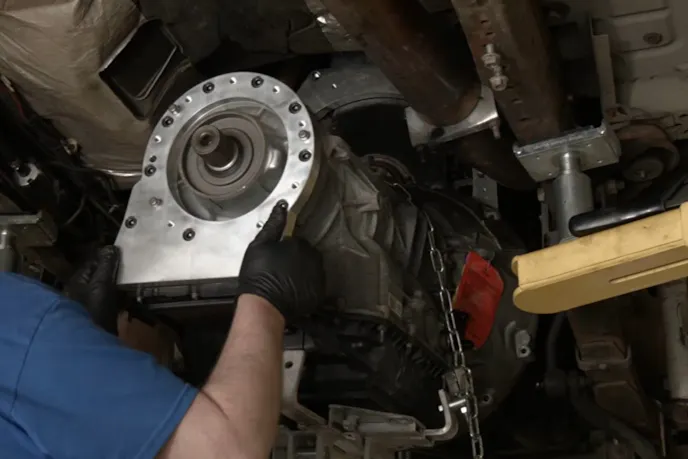
Bolting a transmission designed for a modern 6.7-liter Power Stroke to an engine built two decades earlier requires more than simply changing the bellhousing bolts.
Josh at Performance Adapters developed the adapter system necessary to mate the 10R140 to the older 7.3-liter engine. The initial installation used a prototype adapter, which required some additional fitting and refinement. Feedback and templates from the US Shift team were subsequently incorporated into the production design.
Making the mechanical connection is only one part of the conversion. The transmission must also integrate with the truck’s existing shifter, drivetrain, electronic controls, and cooling system.
Baumann emphasized that retaining an original-equipment appearance was a priority throughout the project.
“We want everything to feel like it came that way from the factory,” he explained.
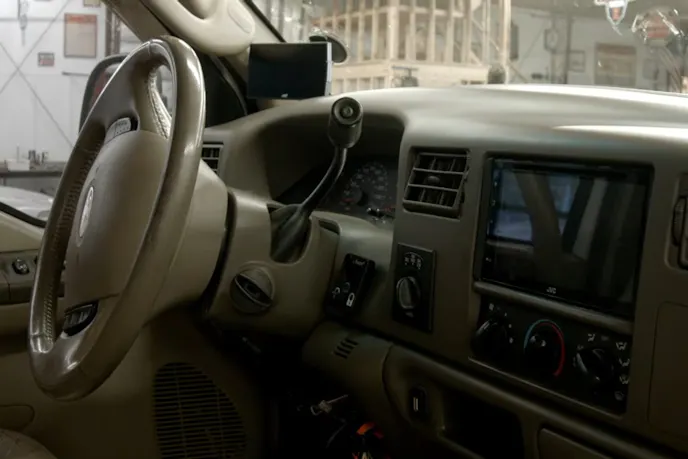
Rather than replacing the factory column shifter with a completely different arrangement, the team developed the necessary linkage and brackets to operate the 10R140 through the original controls. US Shift is also working toward offering those components as part of its conversion support, reducing the amount of custom fabrication required for future installations.
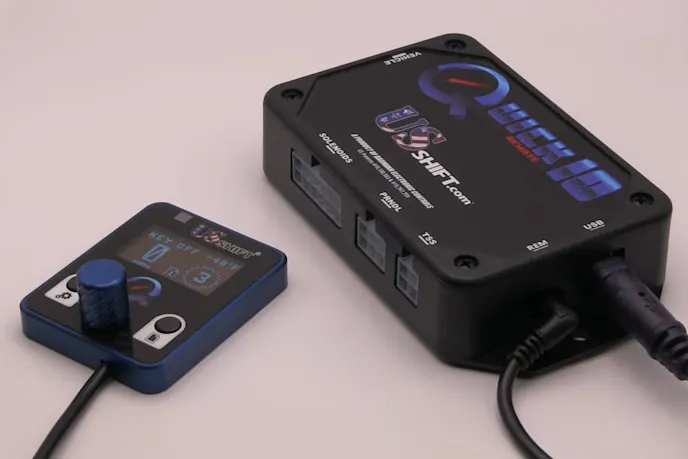
One of the most important components is the company’s Quick 10 standalone transmission control system. Since the 2003 truck’s original electronics were never designed to communicate with a ten-speed automatic, the Quick 10 takes responsibility for operating the transmission and managing its shift behavior.
The controller also incorporates adaptive capabilities that allow transmission operation to be refined as the truck accumulates driving time. Baumann noted that the calibration was still being adjusted, particularly to smooth some of the firmer full-throttle shifts.
Ten Gears Transform The Driving Experience
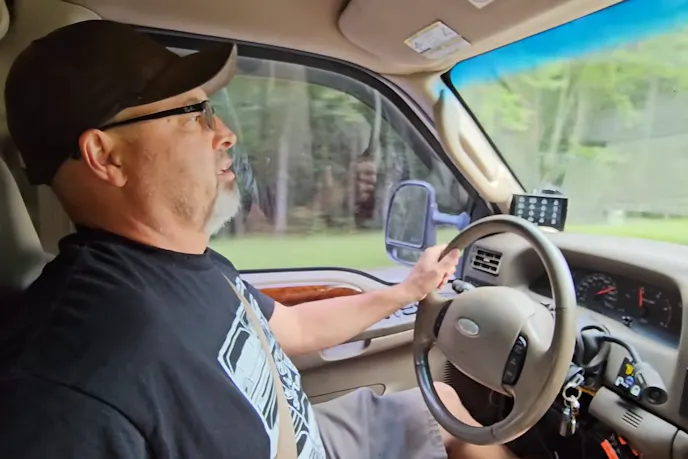
The biggest advantage of the conversion becomes apparent once the truck is moving.
Although the 4R100 is a capable and well-supported transmission, its relatively widely spaced ratios can cause significant engine-speed drops during gear changes. For a turbocharged diesel, that can mean falling out of the most effective portion of the powerband and waiting for boost pressure to rebuild.
Baumann explained that this is particularly noticeable during the shift from first to second gear.
With the 10R140, the additional ratios substantially reduce those engine-speed drops, helping the 7.3-liter Power Stroke maintain boost and deliver more consistent acceleration.
“The boost pressure never drops,” Baumann said while describing the truck’s behavior under acceleration.
The benefits are especially noticeable when accelerating through multiple gears. During testing, the team reported pulling through ninth gear at wide-open throttle, with the engine continuing to deliver strong acceleration. The truck also responded aggressively to passing maneuvers, dropping several gears at highway speeds before accelerating.
The team suggested that the swap had improved the truck’s 0–60 mph performance by approximately half a second to as much as a full second. However, those figures were preliminary estimates rather than independently verified test results.
Importantly, the improved performance doesn’t necessarily come from increasing engine output. Instead, the transmission makes more effective use of the available horsepower and torque by keeping the engine within a narrower operating range.
Of course, this particular 7.3-liter isn’t completely stock. The truck features an upgraded KC Turbo, a four-inch exhaust system, a FASS fuel system, and a Hydra tuning system from Power Hungry Performance.
Baumann estimated the engine could be producing approximately 700 lb-ft of torque, although no chassis dynamometer results were provided to substantiate that figure. Considering the 10R140 was designed for substantially higher torque outputs from modern 6.7-liter Power Stroke engines, the team elected to retain the transmission’s factory internal components.
The additional torque multiplication available in first gear also introduces considerations elsewhere in the drivetrain. Baumann noted that the truck uses 1410-series rear driveshaft U-joints and 1350-series front driveshaft U-joints. Under aggressive boosted launches with sufficient traction, those components could become a limiting factor.
The team therefore discussed using four-wheel drive for future launch testing to distribute the load, while emphasizing the importance of avoiding unnecessary drivetrain damage.
Solving The Electronic Integration Challenges
While the mechanical installation represents a significant achievement, integrating the modern transmission with the 2003 truck’s electronics presents another set of challenges.
The factory engine computer was originally responsible for communicating with the 4R100 transmission. Removing that gearbox means the computer no longer receives the expected inputs or sees the original transmission solenoids.
The US Shift team has been working with Power Hungry Performance to refine the truck’s Hydra engine calibrations and address these issues.
Baumann explained that the truck responded better to throttle inputs when running a manual-transmission engine calibration. Unfortunately, that configuration also introduced instrument-cluster problems because it did not provide the transmission-temperature message expected by the factory gauges.
Reverting to an automatic-transmission calibration addressed some of the communication issues but introduced multiple diagnostic trouble codes related to the missing 4R100 solenoids.
The team is working to suppress the unnecessary fault codes while preserving the improved throttle response of the manual calibration.
The goal is to make the truck behave as though the ten-speed transmission were factory installed, without persistent warning lights or unnecessary compromises in drivability.
Upgraded Transmission Cooling And Filtration
Keeping the 10R140 cool and its fluid clean was another important part of the conversion.
The truck received a large transmission cooler originally intended for a 6.0-liter Power Stroke application equipped with the 5R110 automatic. This is a familiar upgrade among 4R100 owners because of its substantially greater cooling capacity compared with the original cooler.
Although the truck already had an upgraded cooler, the team installed a replacement to eliminate the possibility of introducing contamination into the new transmission.
The cooling system also incorporates an Improved Racing thermostatic filter adapter. The thermostat uses a bypass circuit to limit flow through the cooler when the fluid is cold, allowing the transmission to reach operating temperature more quickly.
As the fluid approaches approximately 160 degrees Fahrenheit, the thermostat progressively directs flow through the cooler, helping maintain a more consistent operating temperature.
Filtration received equal attention. Baumann selected a Baldwin glass-fiber filter, originally intended for commercial refrigeration applications, with an approximately five-micron filtration rating.
The reasoning is straightforward. Automatic transmissions can generate fine clutch-material and metallic particles during normal operation, particularly during break-in. Allowing those contaminants to circulate can accelerate wear in sensitive hydraulic components, including the valve body.
The additional filtration is intended to reduce that risk and improve long-term reliability.
Making The Factory Gauges Actually Work
One of the more interesting developments involves the truck’s factory instrument cluster.
Initially, Baumann considered generating a simulated transmission-temperature signal that would allow the original gauge to function through the factory engine computer. However, he determined that the gauge did not provide the level of accuracy he wanted.
Instead of displaying an actual linear temperature reading, the factory gauge primarily acts as a general operating-condition indicator, with limited movement until temperatures become excessive.
Baumann decided to develop a standalone gauge controller capable of operating the original instrument-cluster needles while providing more meaningful information.
The plan involves disconnecting the factory transmission-temperature and engine-oil-pressure gauges from their original control circuits and operating them through the new module.
Transmission-temperature information would come directly from the Quick 10 controller. For engine oil pressure, the team plans to replace the factory pressure switch with an AutoMeter sending unit, allowing the original gauge to display actual pressure rather than effectively functioning as an on/off indicator.
At the time of the video, this gauge-controller system was still being developed. Baumann suggested that the module could eventually become a standalone product for 2002–2003 Super Duty pickups, with potential applications in other vehicles equipped with similar instrument clusters.
Importantly, the gauge controller is not required to complete the transmission conversion. It represents an additional refinement intended to improve the factory-style integration.
Bringing Modern Performance To An Old-School Diesel
For enthusiasts considering a similar conversion, the foundational components are a suitable diesel-specification 10R140, the appropriate engine adapter from Performance Adapters, and US Shift’s Quick 10 standalone controller.
Additional considerations include transmission mounting, transfer-case compatibility, driveshaft fitment, shifter linkage, cooling-system plumbing, engine calibration, and supporting electronics. These requirements make the conversion significantly more involved than a conventional transmission replacement.
Still, the completed development truck demonstrates just how much difference modern transmission technology can make behind an older diesel engine.
By replacing the original four-speed automatic with a ten-speed capable of maintaining a more consistent operating range, the team has dramatically changed the character of Chad Blotsky’s F-250 without abandoning the 7.3-liter Power Stroke that makes the truck desirable in the first place.
And perhaps that’s the most interesting part of the project. Instead of chasing additional horsepower through increasingly aggressive engine modifications, US Shift and Performance Adapters have demonstrated another way to make an older diesel pickup substantially more responsive and enjoyable to drive.
For 7.3-liter Power Stroke enthusiasts looking to combine old-school diesel durability with modern drivetrain performance, this conversion offers a compelling glimpse at what’s possible.
You might also like
Is Red Diesel Legal Now? What The New Executive Order Means
Trump’s new executive order temporarily opens red-dyed diesel to highway use. Here’s what diesel truck owners need to know.