
President Donald Trump signed an executive order on October 5, 2026, temporarily opening the door for red-dyed diesel fuel to be sold for and used in highway vehicles through the end of the year.
The move is aimed at reducing fuel costs for truckers, farmers, and other diesel users as restricted global diesel supplies and refining constraints continue to push prices higher. But despite some of the headlines circulating online, the order does not permanently make red diesel legal for highway use, nor does it automatically erase every federal and state tax associated with the fuel.
Instead, the executive order creates a temporary window of federal tax and penalty relief running from October 5 through December 31, 2026, while directing the Treasury Department and Internal Revenue Service to put the details into place.
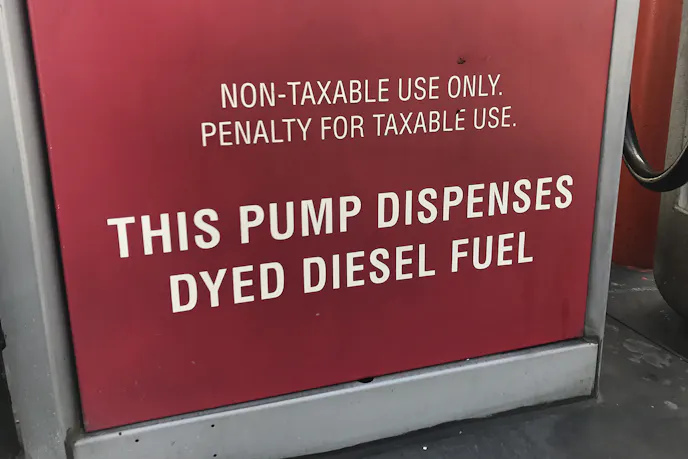
What Is Red-Dyed Diesel?
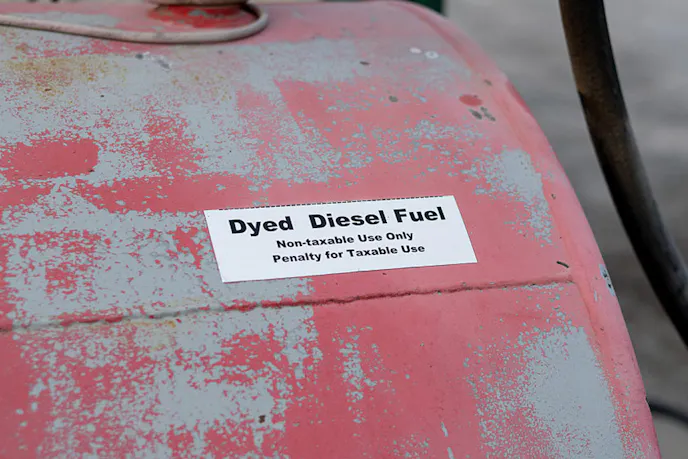
Red diesel is not an exotic or fundamentally different fuel developed specifically for tractors and construction equipment. In normal use, the dye primarily identifies diesel that has been distributed for qualifying nontaxable purposes.
Federal regulations require qualifying dyed diesel to contain a red dye, allowing inspectors to quickly identify fuel that was sold without the normal highway fuel excise tax. The IRS currently imposes a federal diesel tax totaling 24.4 cents per gallon on taxable highway fuel, consisting of a 24.3-cent fuel tax plus a 0.1-cent-per-gallon Leaking Underground Storage Tank Trust Fund tax.
Historically, dyed diesel has been intended for applications such as farm machinery, construction equipment, stationary engines, and other qualifying off-highway uses. Putting dyed fuel into a highway vehicle for a taxable use could expose both the operator and, under certain circumstances, the fuel seller to federal taxes and significant penalties.
That is the piece Trump’s new executive order temporarily changes.
Red Diesel Heads To The Highway
The executive order, titled “Emergency Tax Relief on Diesel Fuel,” directs the Treasury Department to determine whether it can defer certain federal diesel excise-tax obligations incurred between October 5 and December 31, 2026.
More immediately significant for diesel pickup owners and commercial truck operators, the order directs Treasury to have the IRS announce that it will not impose penalties under Internal Revenue Code Section 6715 when dyed diesel is sold for highway use or used on the highway during that same period.
In practical terms, the administration intends to temporarily remove one of the biggest barriers preventing dyed diesel from entering the highway fuel supply.
The White House summarized the action more directly, saying the order temporarily allows off-road dyed diesel to be used on highways while deferring the applicable federal excise tax.
During remarks announcing the order, Trump described the fuel as essentially the same diesel traditionally sold for off-road equipment but without the normal highway tax, and said the goal was to allow broader purchases during the temporary relief period.

How Much Could Diesel Owners Save?
The immediate federal savings potentially available are straightforward.
The federal highway diesel tax is 24.4 cents per gallon. That means eliminating or deferring that charge represents nearly $25 on every 100 gallons purchased.
For a commercial truck taking on 250 gallons, the White House estimates the federal portion alone represents roughly $60 per fill-up.
For owners of diesel pickups, the numbers are obviously smaller per tank but can still add up. A 30-gallon fill represents about $7.32 in federal diesel tax, while 50 gallons works out to approximately $12.20.
Those figures address only the federal side of the equation.
States impose their own fuel taxes and maintain their own dyed-diesel rules, and the executive order cannot simply eliminate those requirements nationwide. The administration is instead directing federal officials to work with states and encourage them to enact corresponding relief.
The White House says savings on a 250-gallon fill could exceed $100 in states that follow the federal government’s lead.

Is The Federal Tax Actually Gone?
This is where the distinction between the announcement and the underlying executive order becomes important. The order does not simply repeal the federal diesel excise tax through December 31.
Instead, Trump directed Treasury to determine whether existing law allows payment of certain taxes associated with highway use of dyed diesel to be deferred. If Treasury determines that authority exists, those payments are to be postponed without interest or penalties to the extent allowed by law.
Treasury is also directed to explore options for eliminating the eventual obligation to pay those deferred taxes, including possible legislative action.
So, while the White House is promoting the program as immediate tax relief, “deferred” and “eliminated” are not necessarily the same thing.
The eventual treatment of those taxes will depend on Treasury guidance and any additional action taken by the administration or Congress.

Can You Put Red Diesel In Your Duramax, Cummins, Or Power Stroke?
At the federal level, the intent of the executive order is clearly to permit dyed diesel to be sold for highway use and used in highway vehicles during the temporary October 5 through December 31 relief period without triggering the normal Section 6715 dyed-fuel penalties.
That would include diesel-powered pickups as well as commercial highway trucks.
There is nothing about the red dye itself that automatically makes the fuel inappropriate for a modern diesel engine. Under normal federal rules, the coloration serves as an identifier for the fuel’s tax status rather than defining an entirely different grade of diesel.
However, fuel quality still matters.
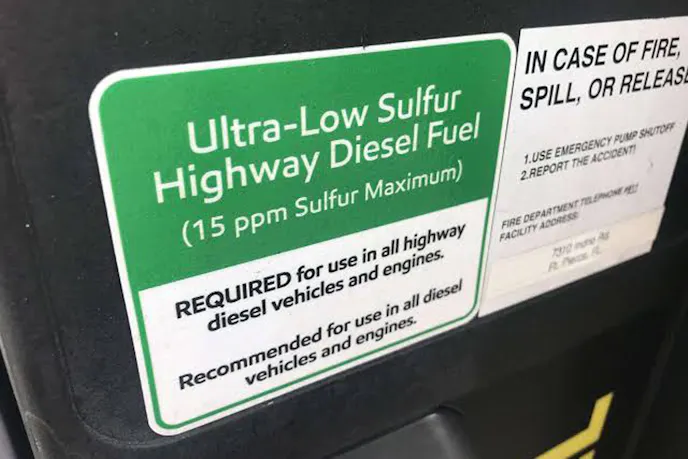
Modern diesel engines equipped with high-pressure common-rail injection systems, diesel particulate filters, selective catalytic reduction systems, and other emissions equipment still require fuel meeting the appropriate specifications. A temporary tax exemption does not make high-sulfur, contaminated, or otherwise inappropriate fuel safe for a late-model diesel.
Past IRS emergency dyed-fuel waivers have specifically noted that fuel exceeding the allowable sulfur content could not be used in highway vehicles even when dyed-fuel penalties were temporarily suspended.
In other words, the color may temporarily cease to be the problem, but the fuel still needs to be suitable for the vehicle.
Don’t Forget About State Law
Perhaps the biggest wildcard for individual truck owners is state enforcement.
Trump’s executive order applies to federal policy. States have their own fuel-tax structures, enforcement procedures, and laws governing dyed diesel.
The order specifically instructs the White House Office of Intergovernmental Affairs to encourage states to adopt corresponding policies and directs the Department of Transportation and Department of Agriculture to coordinate with state governments and fuel distributors.
That language is significant because it confirms that state relief is not automatic.
A diesel owner should therefore not assume that the federal announcement makes red diesel unrestricted in every jurisdiction. State revenue agencies will need to establish how they intend to handle dyed fuel during the federal relief period.
Why Is This Happening Now?
According to the administration, the emergency action is a response to restricted global diesel supplies and rising prices that have placed additional pressure on agriculture, trucking, and other industries heavily dependent on diesel fuel.
The White House specifically cited constrained global supply and insufficient refining capacity as factors behind elevated diesel prices.
Unlike a change that increases crude-oil production months or years down the road, allowing existing dyed-diesel inventories into the highway market has the potential to expand the immediately usable pool of diesel fuel.
The administration is also directing the Department of Agriculture to coordinate with agricultural cooperatives, rural fuel distributors, farm suppliers, and other industry stakeholders to help maintain dyed-diesel availability in areas where demand increases.

A Temporary Change, Not A New Normal
The relief period established by the executive order ends December 31, 2026. Unless additional action is taken, traditional federal dyed-diesel restrictions and tax treatment would again become relevant after that date.
Treasury and the IRS also still have an important role to play. The executive order gives Treasury five days to make several determinations and directs the department to issue guidance covering eligibility, affected tax liabilities, repayment dates, and other details of the program.
As of October 6, the IRS’s current published excise-tax guidance still describes the traditional rules governing dyed diesel and highway use, meaning additional implementation guidance stemming from the new executive order remains important.
For diesel enthusiasts, however, the significance of the announcement is difficult to miss. Fuel that has been synonymous with tractors, heavy equipment, farm tanks, and stiff penalties for highway use is temporarily being opened to America’s road-going diesel fleet.
For the next several months, seeing red fuel in the tank of a highway diesel may carry a very different meaning than it did just a few days ago.
You might also like
A School Bus-Sourced 12-Vavle Cummins Powers This Awesome 1959 Chevy Apache
This awesome 1959 Chevy Apache is a combination of a $500 Marketplace find, a Ford F-250, and a Cummins turbodiesel from a school bus.