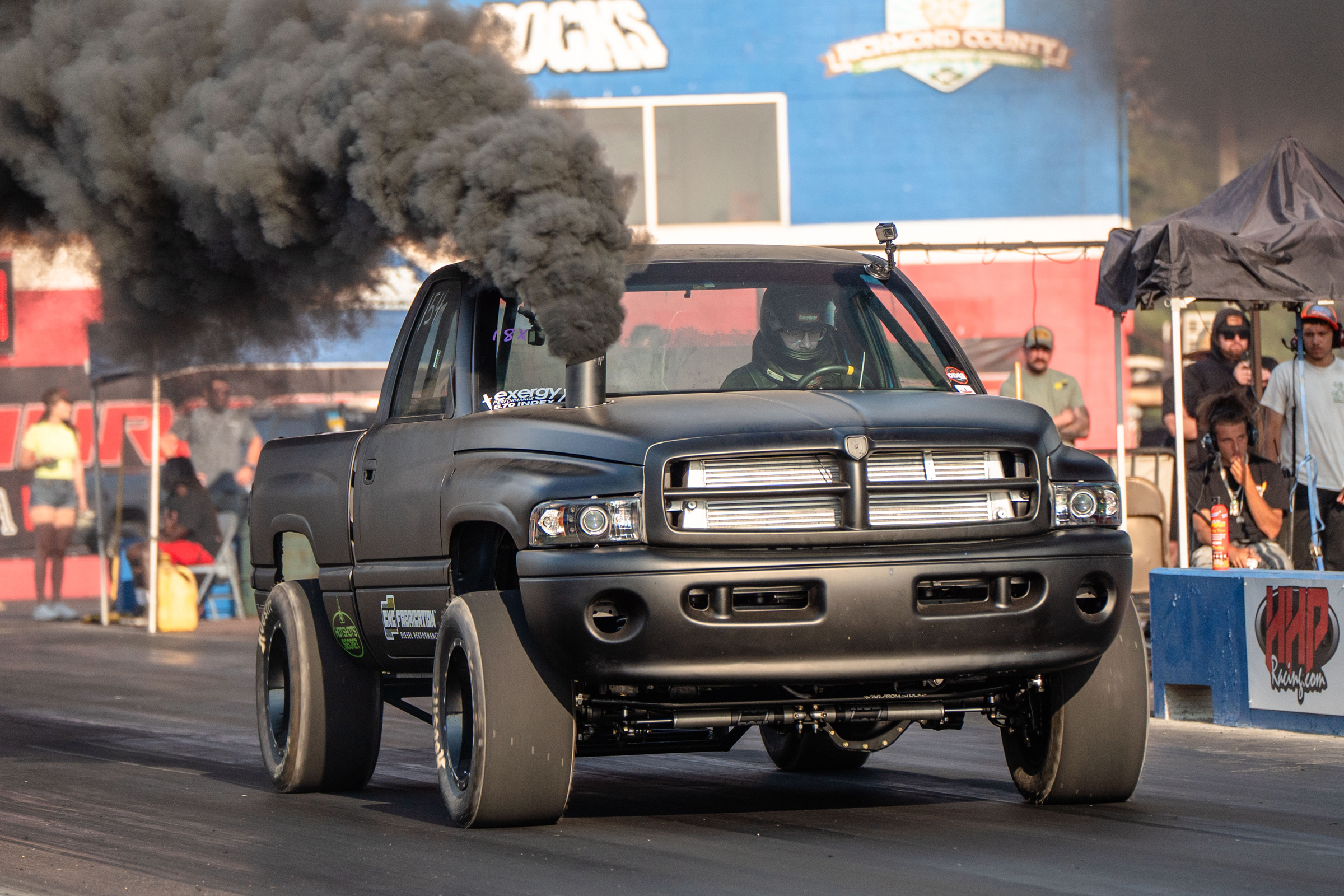
There are easier ways to build a diesel drag truck. Corey Hurtt and the crew at CNC Fabrication Diesel Performance know that better than most. Start with the expected platform, follow the usual recipe, buy the familiar parts, and there is a decent chance the truck will make power, go straight, and fit neatly into the world’s idea of what a diesel race build should be.
This truck does not do that.
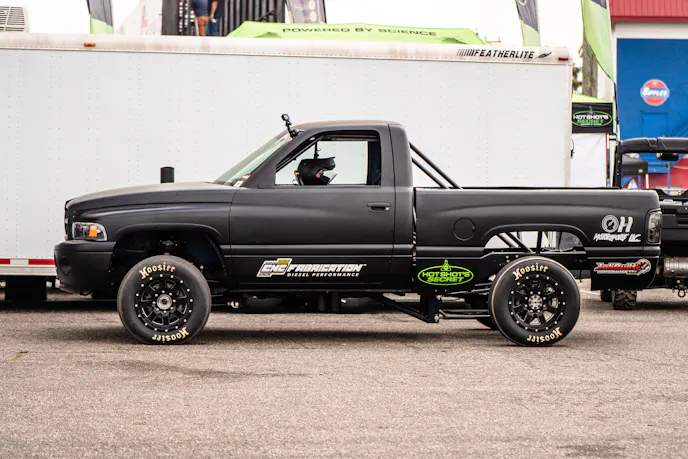
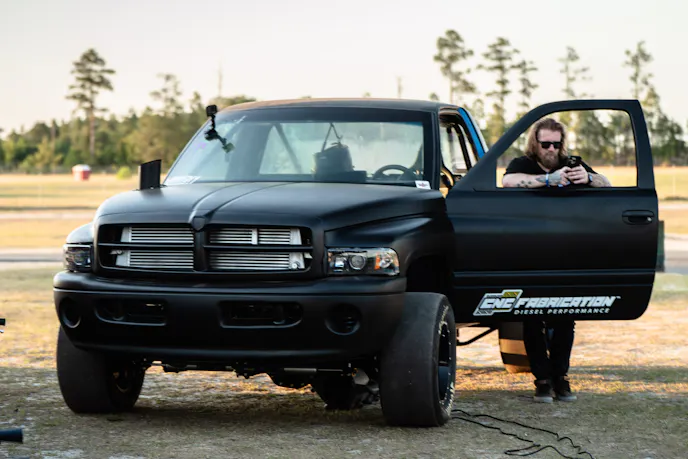
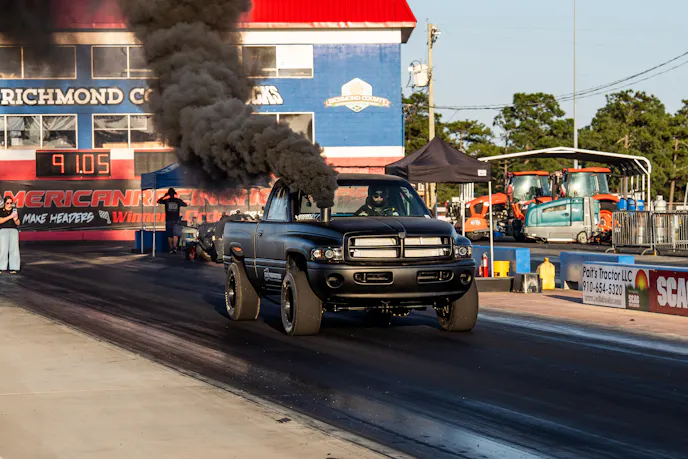
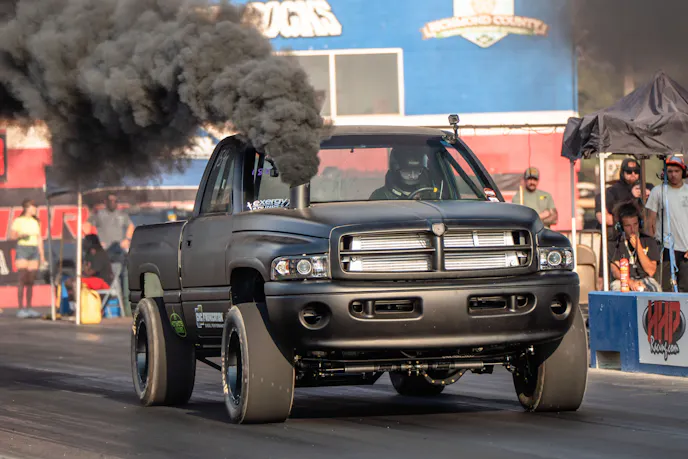
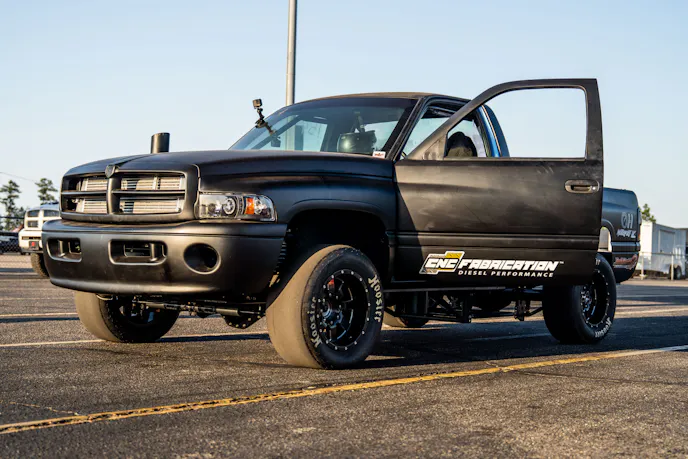
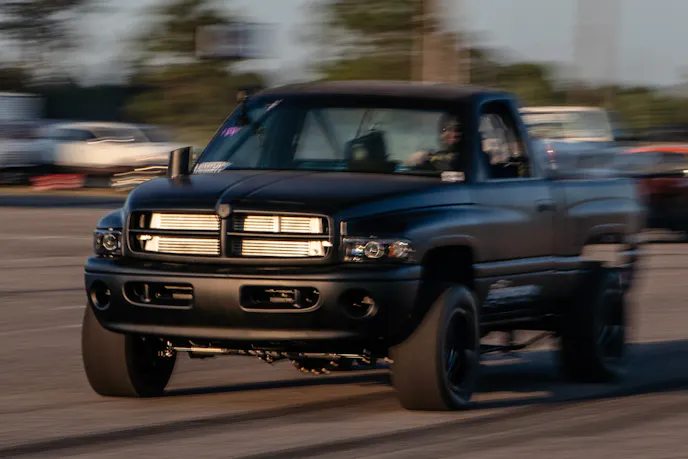
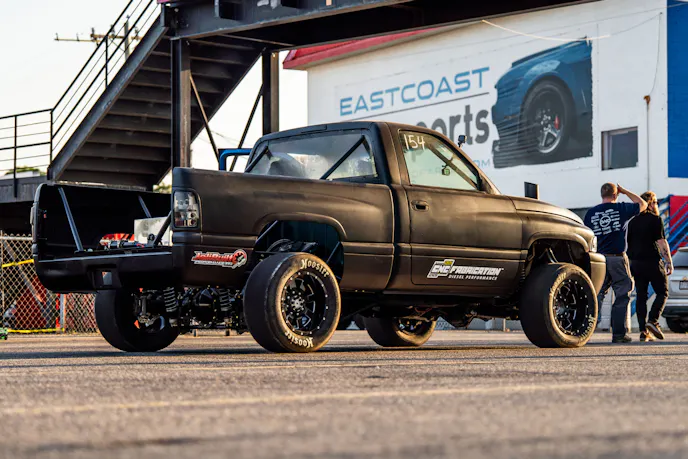
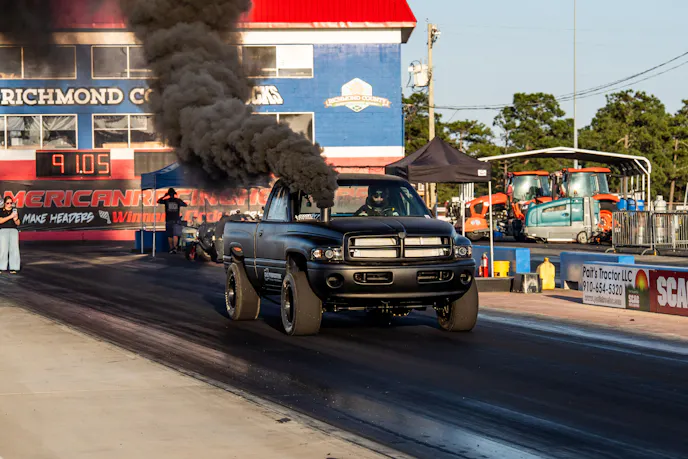
At first glance, the shape is unmistakably second-generation Ram: blunt nose, square shoulders, and just enough old Dodge attitude to look right sitting low over a set of slicks. But the heart of the program is pure CNC Fabrication mischief. Underneath the Ram sheetmetal is a 7.3-liter Ford Power Stroke, built in-house, pushed far beyond the boundaries most people associate with the old HEUI platform, and surrounded by the kind of chassis, fuel, turbo, and nitrous systems that make it clear this is not a novelty swap.
For CNC Fabrication, that point is bigger than simply putting a Ford engine in a Dodge chassis. The company has built its reputation around solving problems for the 7.3-liter Power Stroke crowd, especially in the high-pressure oil, fuel, injector, and hard-part spaces. This Ram is the rolling extreme of that same mindset. It is a test bed, a calling card, and a reminder that the 7.3-liter still has room left in its story when the right people refuse to treat it like yesterday’s engine.
And this season, it has also become a new kind of classroom for driver Matt Ryce.

Learning The PowerRam
Ryce is not new to fast cars. He has spent years behind the wheel of gas-powered race cars, including a bottom-five-second twin-turbo Nova. That background gives him speed, race-day composure, and a healthy respect for power. But it did not make the CNC Fabrication Ram simple.
“It’s my first time driving a diesel race truck, and although I have years of experience driving gas cars, it’s been a complete learning curve for me,” Ryce says.
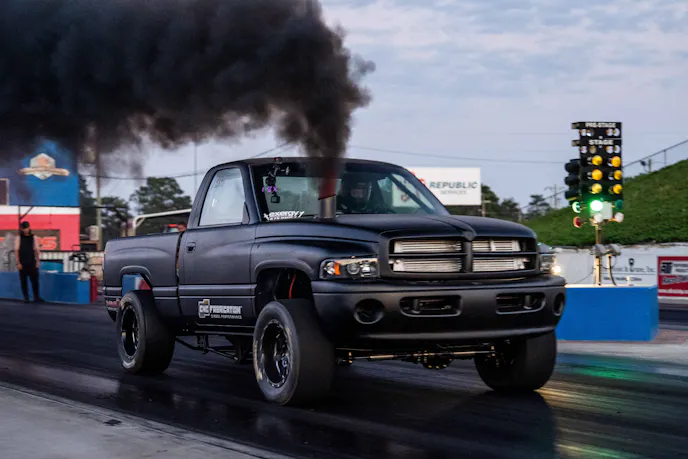
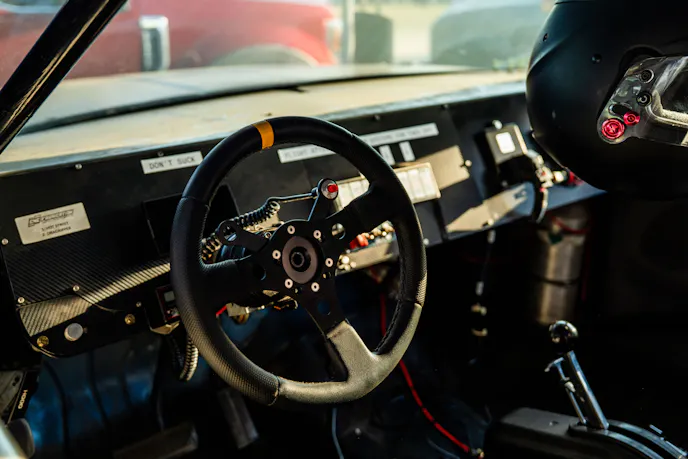
That learning curve begins before the truck ever leaves the starting line. A diesel like this is not staged like a naturally aspirated bracket car or even a familiar boosted gas combination. It has to be brought up on the charger, managed against the brakes, and kept in a narrow window where boost, rpm, converter load, and traction are all ready to agree with each other. Ryce has described that first attempt at spooling and staging the truck at an ODSS event as “using your right foot to thread a needle.”
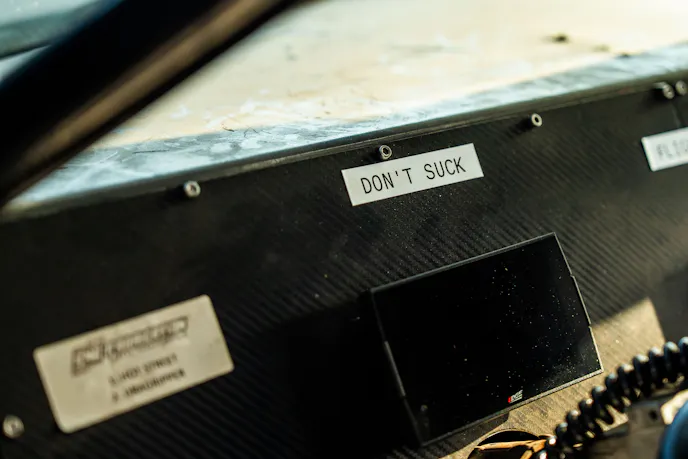
It is a perfect description. This Ram is not just waiting for the driver to mash the throttle. It has to be coaxed into the right attitude, especially with a large-frame turbocharger, three stages of nitrous, four-wheel drive, and a heavy-torque 7.3-liter Power Stroke all trying to meet at the same moment.
“As we improve the tune, and make changes like our new 5 blade S400 turbo, we have been cracking away at having a better spooling and staging truck,” Ryce says.
The Engine That Shouldn’t Be Here
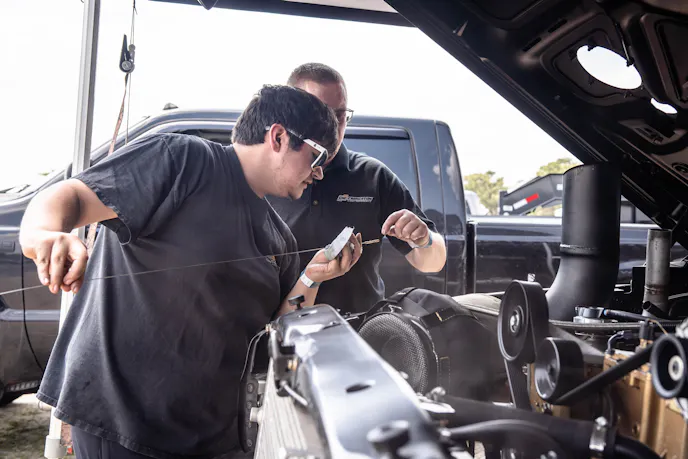
The second-gen Ram chassis gives this truck a visual identity most diesel fans immediately understand. These trucks have always had a drag-strip presence, and the platform carries a natural toughness that fits the look. But the engine bay tells a different story. Instead of a Cummins, Corey and the CNC Fabrication crew built a fully balanced and blueprinted 7.3-liter Power Stroke to live where most people would never expect one.
Inside the block are King bearings, coated and delipped pistons, and Carrillo Pro Series connecting rods secured with ARP fasteners. The pistons were treated for abuse and relieved of the factory lip to better survive cylinder pressure, heat, and the violent pressure rise that comes with big fuel, air, and nitrous.
CNC Fabrication also added its own billet 4140 chromoly bed plate, a critical reinforcement for keeping the lower end stable when the engine is asked to do things the original 7.3-liter architecture was never expected to do. A custom-built CNC Fabrication oil pan completes the lower package.
Breathing Through A Different Kind Of 7.3L
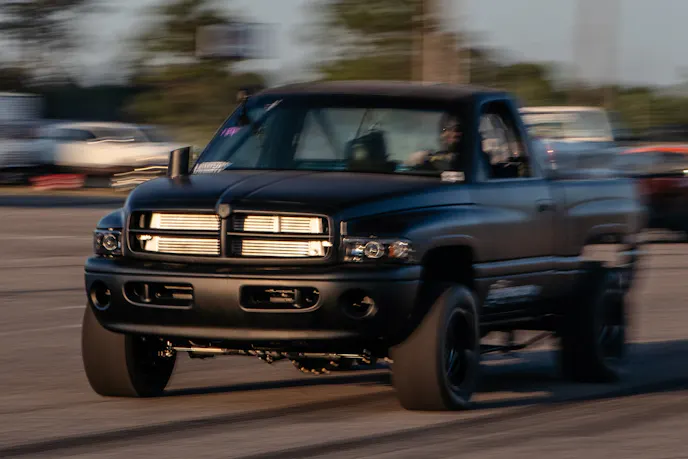
The 7.3-liter Power Stroke’s factory personality is not subtle. It is durable, torquey, and famously stubborn, but it was never known as a high-rpm airflow engine.
The heads have been heavily ported and polished, then modified to work with oversized DT466 Inconel valves. The oversized valves required the block to be bored .060-inch over for clearance, which gives a sense of how committed CNC Fabrication was to making the engine breathe rather than simply turning up the fuel and hoping the turbo would cover the rest.
The camshaft is part of the truck’s lore. It is described as a huge cam originally made years ago for a P-pumped sled-pull engine, though even the team’s notes admit the original grind has been lost to memory. That is fitting. Diesel racing is full of parts with stories, and this cam sounds like one of those pieces that survived long enough to find its perfect home.
Controlling the valvetrain are CNC Fabrication Stage 2 beehive valve springs, a solid-lifter setup, and custom Harland Sharp adjustable rocker arms.
HEUI, But Not As You Know It
The 7.3-liter Power Stroke’s HEUI injection system has always made it different from the mechanical and common-rail combinations that dominate diesel racing. Instead of relying only on fuel pressure, the system uses high-pressure oil to actuate the injectors.
The truck runs CNC Fabrication 450/400 injectors, massive pieces in 7.3-liter terms, paired with a CNC Fabrication prototype single high-pressure oil pump. The word “prototype” is doing a lot of work here. This is the kind of part you build when existing solutions do not match the goal. Feeding those injectors with enough high-pressure oil from a single-pump arrangement is exactly the type of challenge CNC Fabrication has built a business around.
CNC Fabrication high-pressure oil pump lines complete the oil-side package. On a normal street-driven 7.3-liter, upgraded HPOP lines are often discussed in terms of leak prevention, reliability, and cleaning up the factory high-mileage hardware. In this truck, the same concept is pushed into a far more extreme environment. The lines are not there because they look good. They are there because oil pressure is injector control, and injector control is horsepower.
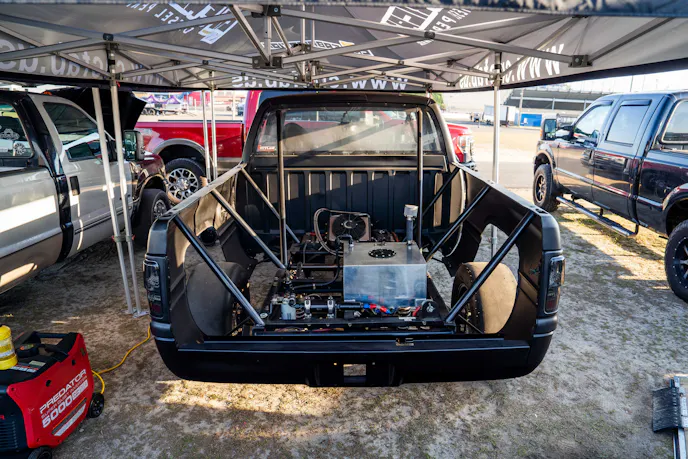
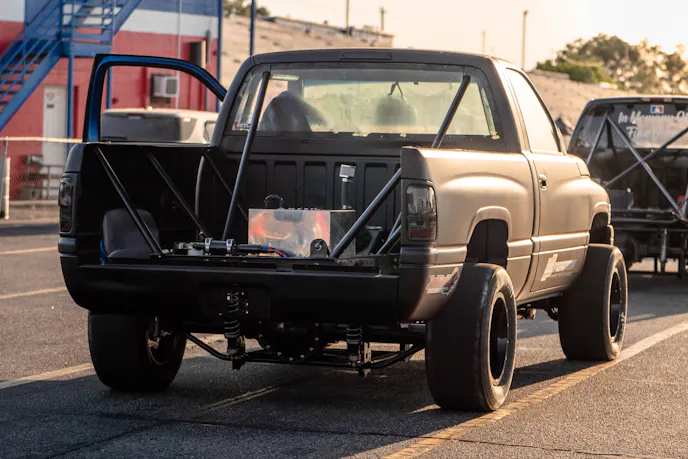
The fuel side is just as deliberate. A CNC Fabrication four-line feed fuel system works with a FUELAB Prodigy pump to keep the injectors supplied. The four-line feed layout gives the engine the kind of fuel distribution strategy a serious HEUI build needs, while the Prodigy pump brings serious fuel delivery into the mix. A 15-gallon fuel cell keeps the truck fed between rounds.
A Driver With A Laptop
Ryce’s learning curve has not been limited to the seat. Part of the fun, and part of the challenge, has been stepping into the tuning side of a platform that behaves nothing like the gas combinations he knows.
“It’s been fun to open up the laptop and take a step into a new world as I try to sort some of the tuning aspects,” he says. “The software is nothing like a Holley, and although I may not have much knowledge in diesel specific tuning, I am starting to apply race day changes to overall drivability.”
That is an important detail because this truck is not just being driven around problems. The team is working through them. Spooling, staging, drivability, and race-day consistency are being improved together. Every change to the tune affects how Ryce can bring the truck into the beams. Every change to the turbo combination affects how the converter, nitrous, and four-wheel-drive system feel from the driver’s seat.
For a gas-car driver, diesel torque changes the mental math. A twin-turbo Nova may be quicker, but the way this truck applies power is a different kind of thrill.
“One would think that after driving my bottom 5 second twin turbo Nova, the PowerRam would be a little less exciting, but that’s not the case,” Ryce says. “The combination of diesel torque, 4wd, and dual power adders, turbo and nitrous, is definitely something that I think all racers should experience.”
Air, Spray, And The Violence In Between
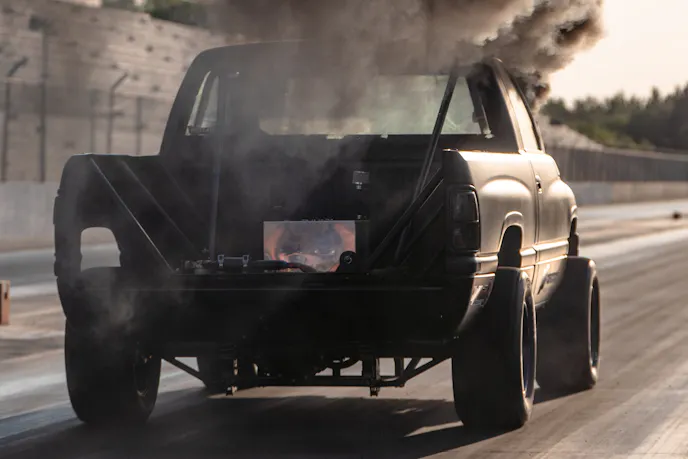
At the center of the air system is a turbo combination that has evolved with the truck. The spec sheet lists a Stainless Diesel S475 5 Blade Mafia turbo, while the current direction includes the new five-blade S400-style charger Ryce references as part of the team’s effort to improve spooling and staging. The truck has also been run with a Hart’s X275 charger, further emphasizing that the turbo program is not static. CNC Fabrication is trying to find the best match for the engine, chassis, driver, and class environment.
The Stainless Diesel 5 Blade Mafia name carries its own meaning in modern diesel performance. Five-blade compressor technology has become a recognizable part of high-performance diesel turbocharger development, and on a big single S400-frame charger, the goal is airflow with response and attitude to match. The Hart’s X275 charger moves the combination into another world entirely, with drag-race turbo hardware designed around tight class rules and serious power potential.
The turbo system is controlled with a TiAL wastegate, while intake charge temperature is managed by an On3 intercooler and a Subaru WRX radiator. That last detail is the kind of packaging solution you only find on a build where function outranks convention. The WRX radiator is not there because it belongs in a diesel truck. It is there because it fits the job Corey needed it to do.
Then there is the nitrous.
A Nitrous Express Maximizer system controls three stages of spray, giving the truck another layer of tuning authority. On a diesel combination like this, nitrous can be used to bring the charger alive, clean up fuel, and add power where the track and tune will accept it. Three stages give the team room to shape the hit rather than simply throwing everything at the engine at once.
The Transmission Between Two Worlds
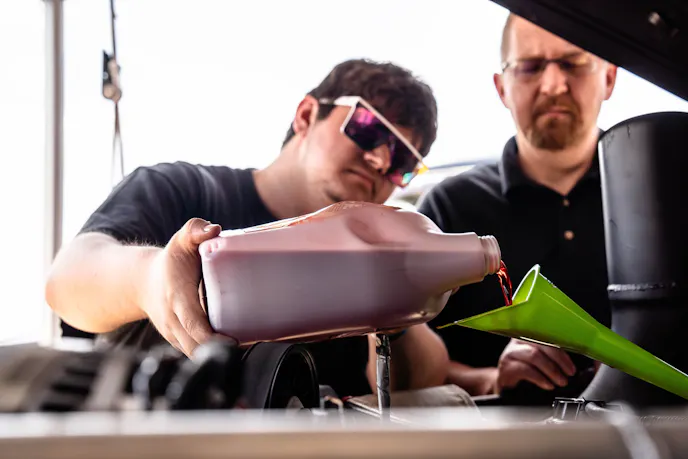
Backing the 7.3-liter is a Sam Wyse Stage 4 full billet race transmission, matched to a Goerend 2,500-stall triple-disc converter. That pairing is a major part of how the truck turns engine output into track performance.
The Stage 4 Sam Wyse transmission is the type of unit meant for four-digit-horsepower diesel abuse, with billet hard parts and clutch capacity intended for drag racing and sled pulling. That is important because the 7.3-liter in this truck is not sending a smooth, gentle power curve rearward. It is feeding the transmission with big HEUI fueling, a large single turbo, and staged nitrous. The transmission has to survive torque, rpm, boost, and the converter charge that comes with launching a combination this aggressive.
The Goerend triple-disc converter is just as important. A 2,500-stall converter in a diesel drag application has to help the engine get into its power without turning the launch into tire smoke or laziness. Too tight and the truck struggles to light the charger. Too loose and it gives away efficiency.
A Chassis Built To Take A Hit
The Ram’s chassis package reads like it was assembled by people who understand that a diesel drag truck can overpower itself long before it runs out of horsepower.
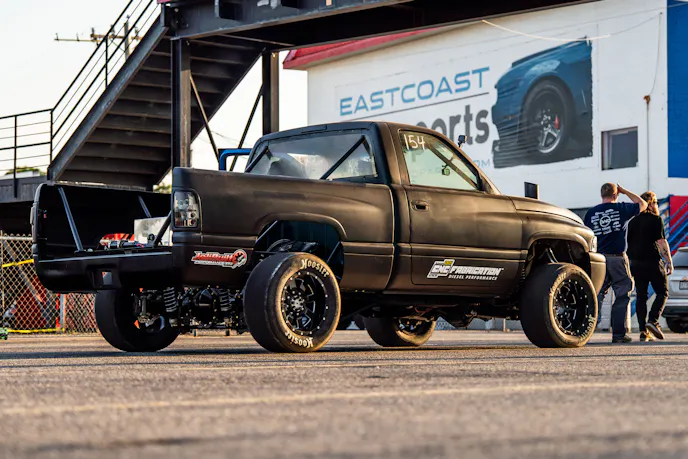
Out back, CNC Fabrication built its own rear four-link system. The rear suspension is one of the most important parts of the whole truck because it dictates how the power gets introduced to the track. With the torque curve and mass of a diesel combination, the chassis has to manage load transfer without upsetting the tire. A well-sorted four-link gives the team the adjustment window needed to chase track conditions and power levels.
The front suspension is equally serious. Far From Stock chromoly adjustable four-link arms are joined by a chromoly drag link, shortened pitman arm, and chromoly tie rod. Dual Fox steering stabilizers from Far From Stock help keep the nose under control. Penske coilovers sit at all four corners, giving the truck race-grade damping and height control.
The truck rolls on Hoosier 29.50×10.5 slicks, a tire choice that reinforces how serious the chassis needs to be. A 29.5-inch-tall, 10.5-inch-wide slick does not leave much room for sloppy power delivery. If the boost, nitrous, converter, four-link, and shocks are not working together, the tire will be the first to say so.
The axle package is unconventional, too. Up front is a 9.25-inch AAM axle with a Truetrac, while the rear is a 10.5-inch GM-version AAM axle fitted with 3.31 gears and a spool. Stopping it is handled by an Innovative brake conversion with Wilwood six-piston front calipers and dual Wilwood rear calipers.
“It Really Helps When You Use It”
Every new race program has a moment that breaks the tension. For Ryce, that moment came during testing at the first ODSS race at Rudy’s.
“To date my funniest moment was in testing during the first ODSS race at Rudy’s,” Ryce says. “While staging the truck I was super confident in the way it was reacting, only to build boost and end up doing a burnout at the tree.”
The culprit was not a lack of driving ability, or a bad tune, or a problem with the truck. It was simpler than that.
“It seems that I didn’t quite remember to check the 4wd lever,” Ryce says. “Although embarrassing, it really broke the tension of being a new driver, in an unfamiliar platform.”
After backing up and getting the truck locked into four-wheel drive, track prep professional Ralph walked up to the window and delivered the line that summed up the whole moment.
“The first words out of his mouth were, ‘It’s not your Nova, this has 4wd,’” Ryce says. “To which I replied, ‘It really helps when you use it.’”
More Than A Swap
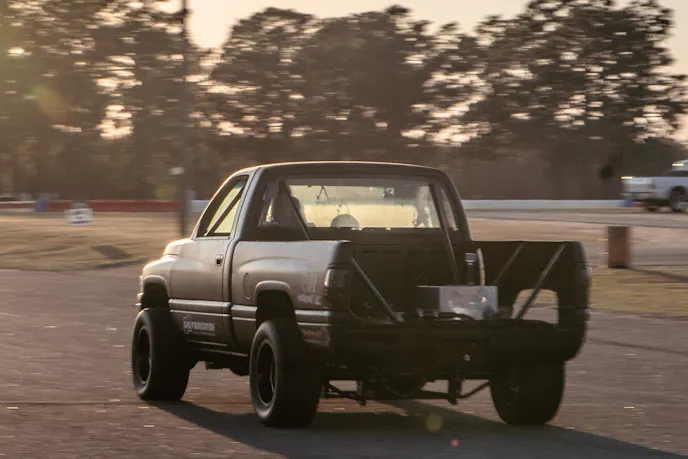
It would be easy to describe this build as a 7.3-liter Power Stroke-swapped Dodge and leave it at that. The combination is unusual enough to get attention on its own. But that undersells what Corey Hurtt and CNC Fabrication have actually built.
This truck is not interesting because the engine and chassis came from different brand families. It is interesting because the swap makes sense once you understand the company behind it. CNC Fabrication has spent years developing parts for the 7.3-liter Power Stroke platform, and this Ram gives the team a place to push those ideas harder than any street truck ever could. The prototype single HPOP, 450/400 injectors, four-line feed fuel system, HPOP lines, bed plate, oil pan, and valvetrain package are not random details.
It is also now a driver development story. Ryce brings fast-car experience, but the PowerRam is teaching him a new dialect of racing. The language includes HEUI tuning, boost control, 4WD staging, nitrous management, and the delicate art of bringing a diesel to life at the tree without overpowering the tires or the brakes.
There is something deeply diesel about the whole thing. The truck is a mix of proven parts, custom fabrication, old knowledge, new development, and a little bit of stubbornness. It borrows where it needs to, builds where it has to, and ignores brand loyalty in favor of performance. A Dodge chassis, a Ford engine, a GM-style AAM rear axle, a Subaru radiator, high-end drag-race turbo hardware, and CNC Fabrication’s own Power Stroke parts all meet in one machine.
You might also like
Grind Hard Diesel Swapped The World's Cheapest Electric Car!
Grind Hard Plumbing Co. built a turbodiesel electric car. The modified Chang Li hit the dirt trails with a new 420cc engine.