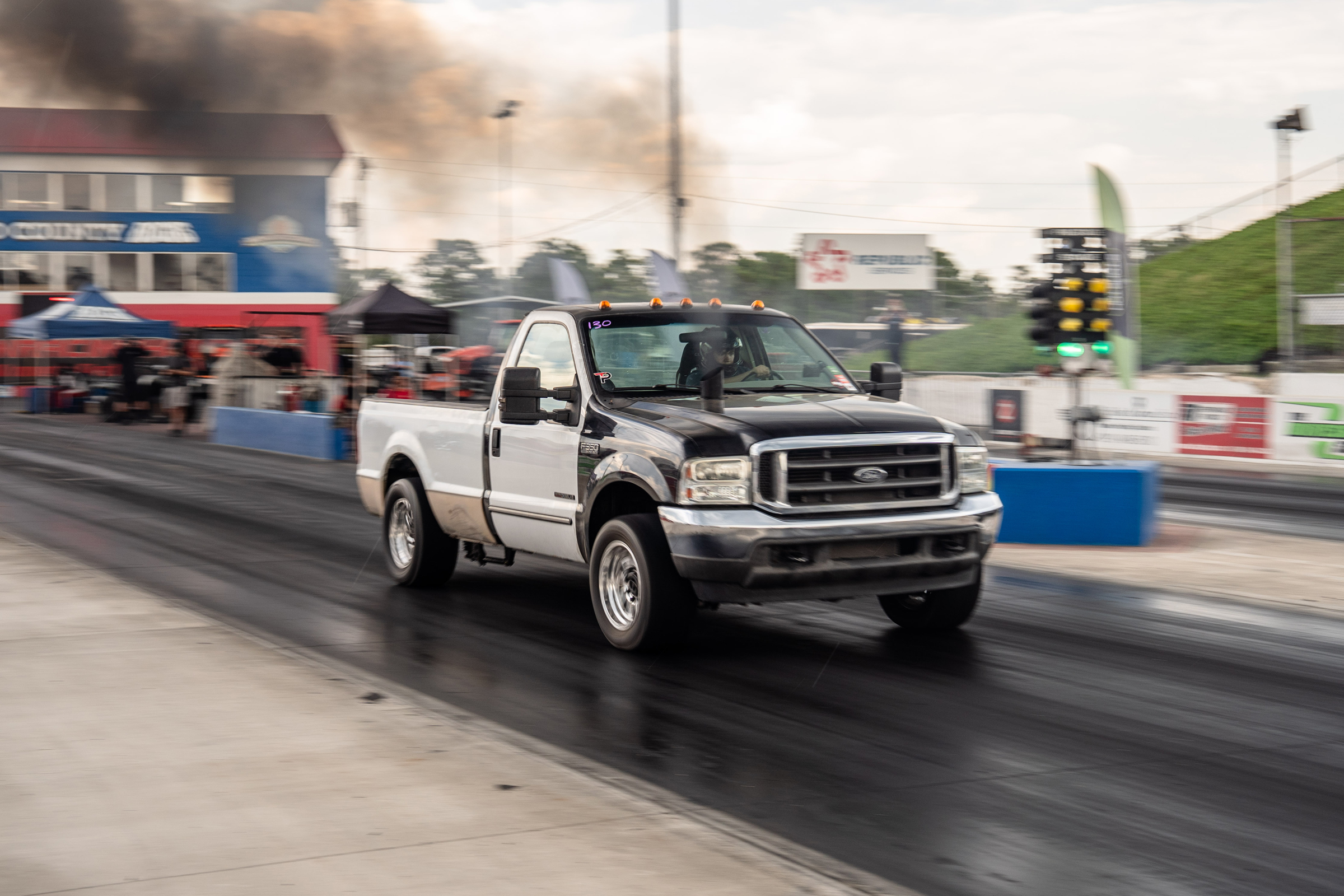
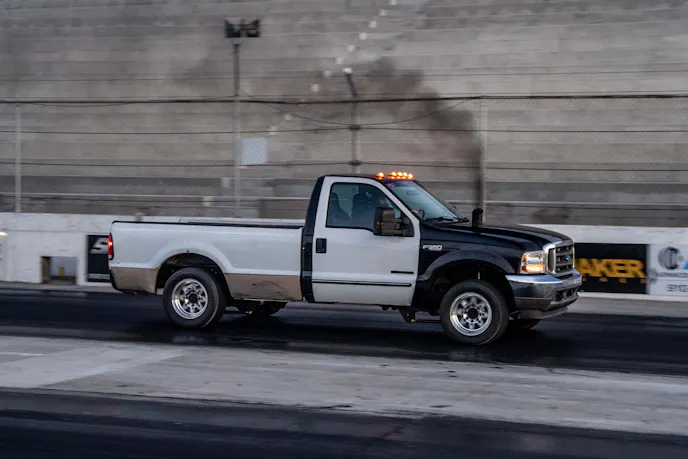
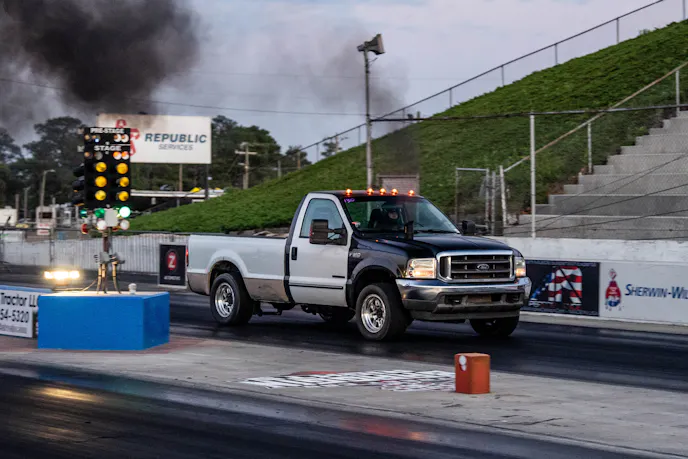
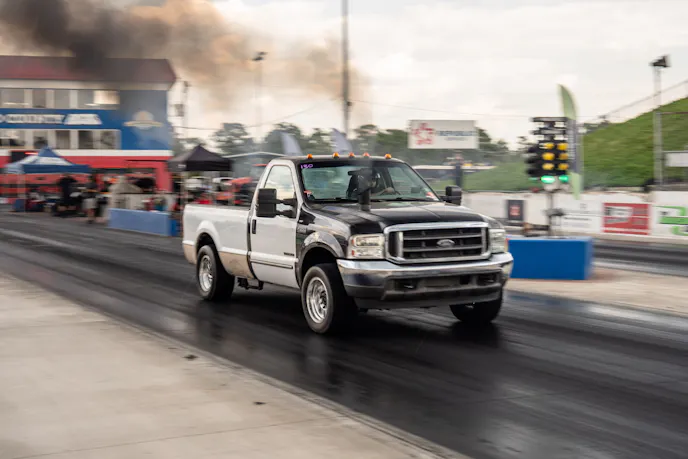
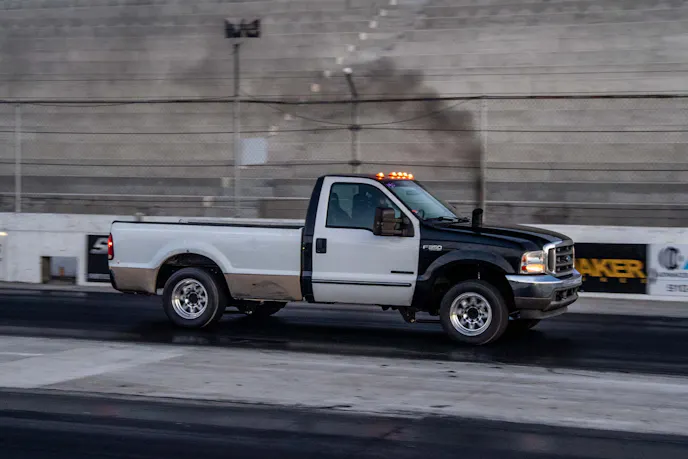
There are cleaner trucks. There are lighter trucks. There are certainly trucks wearing body panels that all agree on a color. But if the purpose of a sleeper is to make the other lane reconsider a few assumptions after the tree drops, Ethan Hurtt’s 2001 Ford F-350 is doing the job exactly as intended.
Hurtt’s single-cab Super Duty began about as far from a purpose-built drag truck as possible. He found the stock, base-model F-350 on Facebook Marketplace when he was 15 years old. The price was $3,000, and the truck had enough problems that it would not reliably run when he bought it. The original idea was practical: living in Ohio, Hurtt needed a dependable four-wheel-drive truck for winter. He repaired it, put it back on the road, and then encountered the familiar problem that has derailed countless sensible diesel projects—he wanted more power.
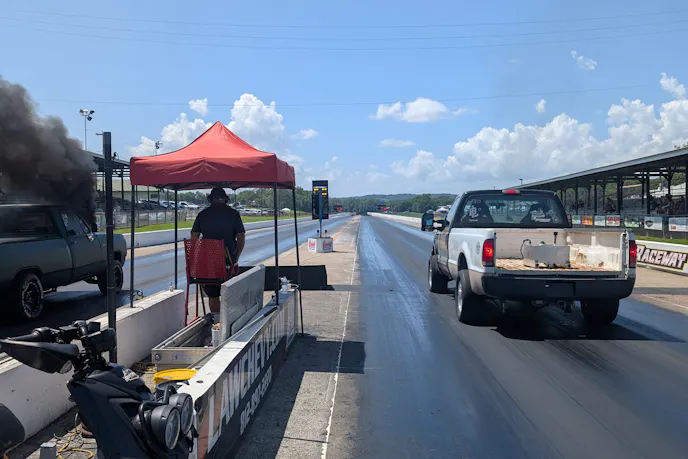
Four years later, that inexpensive Marketplace purchase had progressed from a mild dirt-drag setup into a dedicated asphalt-oriented combination that Hurtt brought to the staging lanes at the 2026 Ultimate Callout Challenge at Lucas Oil Indianapolis Raceway Park. The body remains deliberately rough around the edges, an aesthetic Hurtt embraces because the truck’s sleeper personality is part of the appeal. Underneath, however, the parts selection tells a very different story.
The truck is not simply a 7.3-liter with a big tune and sticky tires. Fuel delivery, high-pressure oil, turbocharging, valvetrain, transmission, suspension, axles, brakes and chassis control have all been addressed. The result is a build designed around one very specific goal: proving the venerable 7.3-liter Power Stroke does not have to spend its retirement telling stories about how reliable it used to be.
A 7.3-liter With Something To Prove
Hurtt grew up particularly close to the platform. His father, Corey Hurtt, owns CNC Fabrication Diesel Performance, and Ethan has consequently spent much of his life around 7.3-liter Power Stroke performance. The father-and-son relationship has also been an integral part of this truck’s development. Ethan readily acknowledges that they do not always agree on how to approach a problem, but he also credits his father’s experience and advice, along with help from others in the diesel-performance community.
That background helps explain why the engine combination attacks several of the 7.3-liter’s interconnected systems rather than relying on one oversized component to carry the entire package.
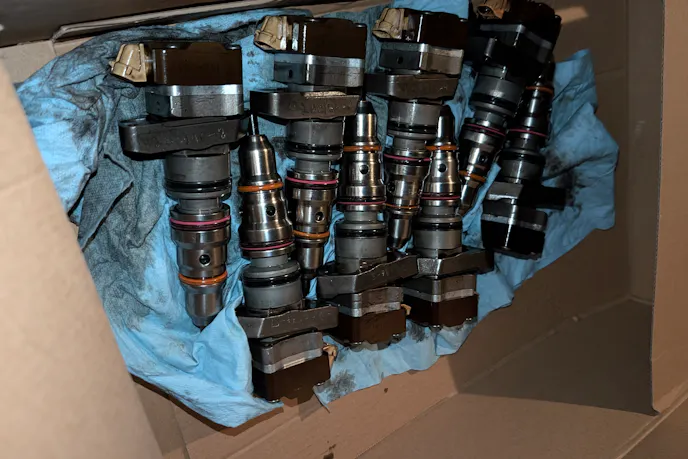
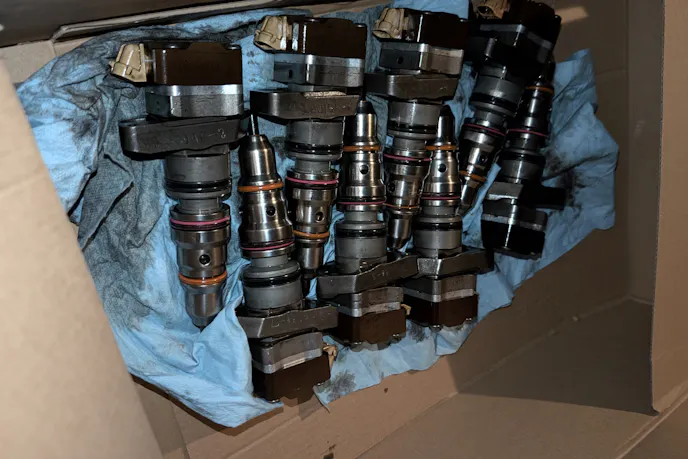
Fuel enters the engine through CNC Fabrication 250/200 hybrid injectors. The company’s nomenclature identifies a 250cc-class hybrid injector with a 200-percent nozzle option. CNC describes its 250/200 Super Street injector as the higher-output version of the 250cc package and says this injector size can typically support approximately 550 to 600 hp when paired with the necessary supporting modifications. CNC also warns that the 200-percent nozzle generates more exhaust heat than the 100-percent version and recommends serious consideration of bottom-end upgrades at this level.
Supporting those injectors on the oil side is a CNC Fabrication Stage 2 high-pressure oil pump, along with a three-line HPOP plumbing arrangement. That is a significant consideration on a HEUI-injected 7.3-liter, where injector operation depends on the high-pressure oil system rather than fuel pressure alone.
CNC rates its 1996-2003 Stage 2 HPOP at approximately 30 percent more flow than a new 1999.5-2003 Bosch pump and says it is intended primarily for roughly 230cc to 250cc hybrid injectors. The company specifically notes that 250/200 injectors can be run with the pump, although it does not guarantee that the pump will maintain demand under every aggressive race calibration. That makes oil-pressure data particularly relevant on a combination like Hurtt’s rather than something to check only when a problem develops.
The upgraded high-pressure plumbing is equally purposeful. CNC’s Super Duty HPOP hoses use a Teflon lining, Brennan hydraulic fittings and Viton O-rings; the company publishes a 16,000-psi burst rating and nominal working pressure of 5,000 psi at 72 degrees F, derated to 3,000 psi at 400 degrees. Hurtt’s three-line configuration also adds the crossover hose between the cylinder-head oil rails, rather than relying only on the two pump-to-head lines.
Feeding All Eight
Low-pressure fuel delivery has received similar attention from a CNC Fabrication valley-mounted four-line feed system, fuel-filter relocation kit, an AEM fuel pump and a 15-gallon fuel cell.
On the 1999.5-2003 version of CNC’s valley-mounted system, fuel is distributed through a billet T-6061 aluminum manifold and 304 stainless-steel hard lines, with high-flow Brennan compression fittings and a -8 AN inlet. CNC designed the four-line layout to remove a number of the factory fuel-bowl leak points while feeding the cylinder heads more directly. The company states that the system can be used with injector combinations ranging from stock through competition applications.
Air In, Exhaust Out
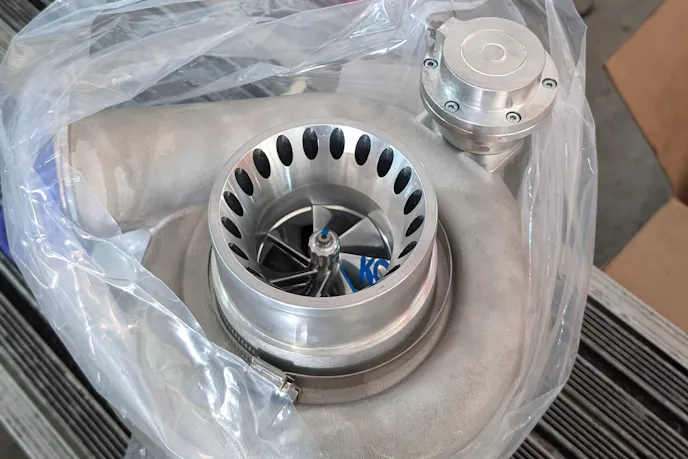
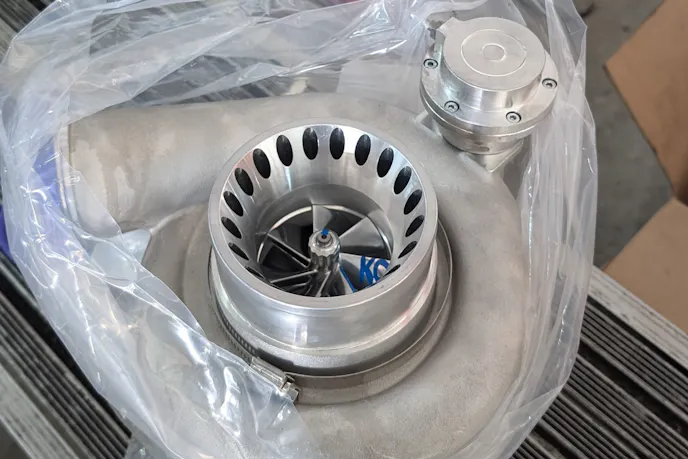
On the air side, the 7.3-liter uses a KC Turbos Gen 3 Stage 3 turbocharger, along with KC up-pipes and a KC turbo pedestal. CNC Fabrication billet intake plenums and an intercooler boot kit round out the intake-side hardware.
For a late-1999-through-2003 7.3-liter application, KC’s current Gen 3 Stage 3 drop-in turbo uses a redesigned 7×7 SXE-style compressor wheel, SXE-style turbine wheel, a 0.70 A/R ported compressor cover and a 0.91 A/R turbine housing. KC also redesigned the bearing housing around substantially larger thrust and journal bearings and strengthened the turbine shaft for elevated boost and power levels.
There is an interesting detail in the pairing. KC officially describes the Gen 3 Stage 3 as supporting injector combinations up to 250cc/100-percent, while Hurtt’s build sheet specifies 250/200s. CNC, meanwhile, characterizes the 200-percent nozzle as the more power-oriented—and hotter-running—version of its 250cc injector. On paper, that leaves Hurtt with a notably fuel-capable combination relative to KC’s published injector recommendation for the turbo, making calibration and management of the air/fuel relationship especially important.
And this is where the truck’s tuning package matters.
A Power Hungry Performance Hydra chip carries custom files and support from Jelibuilt Performance. Hurtt can therefore make use of the Hydra hardware while running calibrations tailored to the large injectors, upgraded HPOP, turbo and transmission rather than generic stock-injector programming. There’s also an Edge CTS3 monitor for keeping vehicle data in front of the driver.
Keeping The Valvetrain Under Control
Higher cylinder pressure and increased airflow are not terribly useful if the valvetrain loses control of the valves, so Hurtt’s parts list includes Manton pushrods and CNC Fabrication Stage 2 beehive valve springs, along with CNC head studs.
CNC’s published specifications for those Stage 2 springs show a 1.880-inch installed height with 155 pounds of seat load, 377 pounds of open load at 1.280 inches and a recommended maximum valve lift of 0.600 inch. Coil bind is listed at 1.210 inches. CNC positions the spring package specifically for higher-output 7.3-liters beyond the 500-hp range.
Getting It Through The Drivetrain
Once the engine produces the torque, the next challenge is convincing the rest of the truck to survive it. A Sam Wyse-built automatic transmission sits behind the Power Stroke, paired with a Goerend torque converter and CNC Fabrication flexplate.
Four Links, Four Tires And A Dana 60
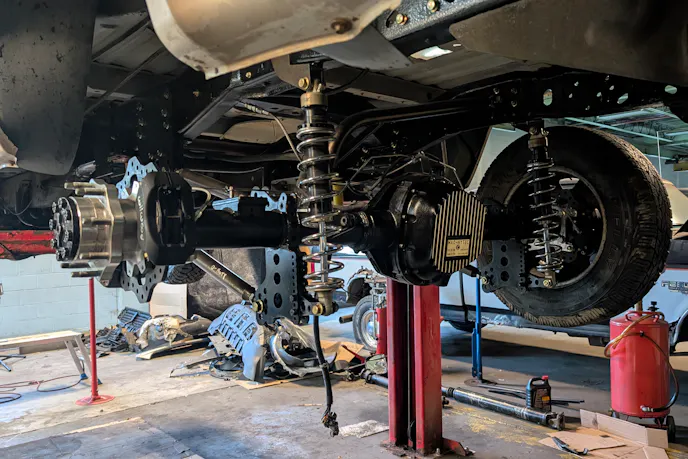
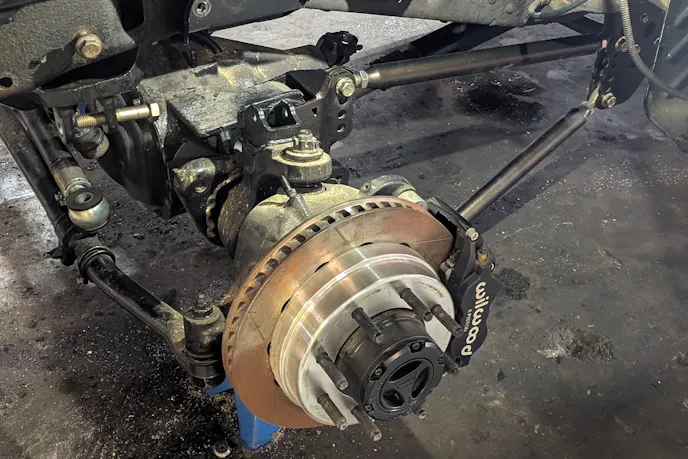
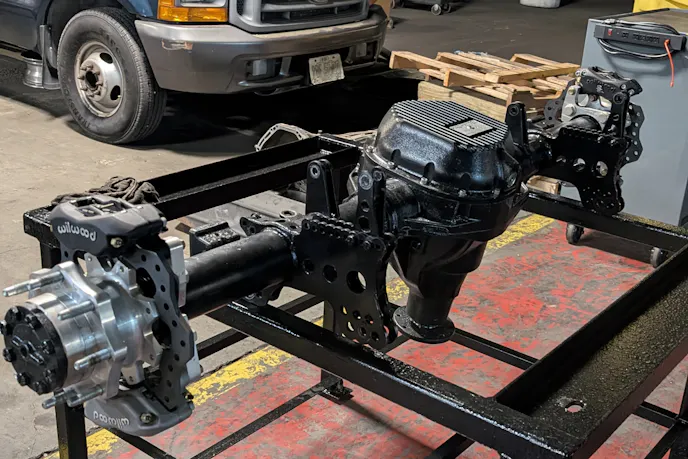
Hurtt did not stop with powertrain modifications. Both ends of the F-350 have been converted to CNC Fabrication four-link suspension systems. QA1 coilovers handle the front while Penske coilovers are used in the rear, and the front axle has been swapped to a 2005-2007 Dana 60.
That is the hardware that really reveals how far the project has migrated from its original Ohio-winter mission. Four-link geometry provides a far greater degree of control over axle motion and load transfer than the factory arrangement, while coilovers allow spring and damper behavior to be tailored around the truck’s weight and launch characteristics.
At the rear is an Eaton Truetrac differential. Rather than operating as a conventional clutch-pack limited-slip unit, Eaton’s Truetrac uses helical gears to bias torque between the axle shafts automatically. Eaton describes the design as maintenance-free, with smooth engagement and no special friction modifiers required. For a truck that still carries a sleeper identity while needing both rear tires to contribute under acceleration, the choice fits the broader character of the build.
Raceline wheels and Hoosier slicks provide the final connection to the track.
Stopping A Three-Quarter-Ton Missile
Acceleration gets most of the attention in diesel drag racing. Stopping a full-size pickup repeatedly is somewhat less glamorous right up until it becomes very important.
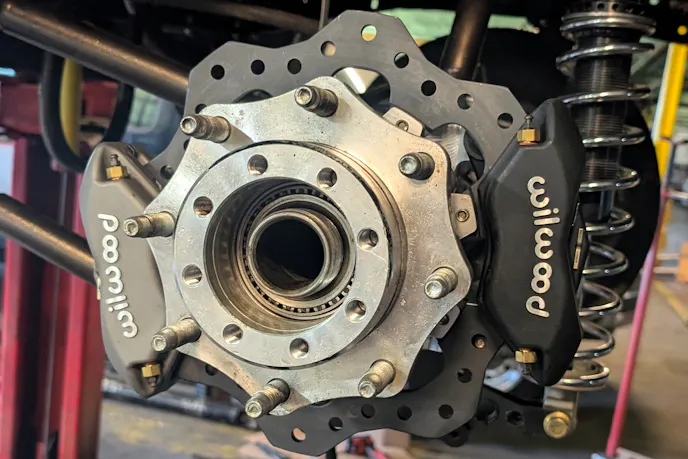
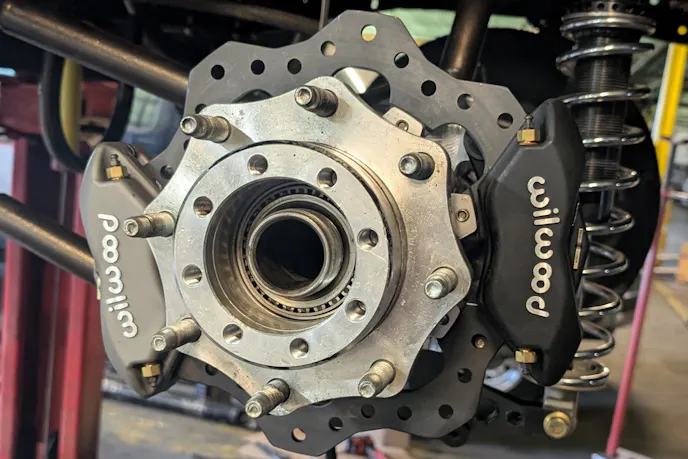
Hurtt’s truck uses dual Wilwood rear calipers and performance rotors. Wilwood’s dedicated drag-racing catalog includes rear systems engineered around the competing demands of stopping torque, heat management and reduced component mass, particularly for high-speed or heavy vehicles that place significant load on the rear brakes. With an F-350, the adjective “heavy” needs little elaboration.
The Best Part Is That It Still Looks Like That
Then there is the body.
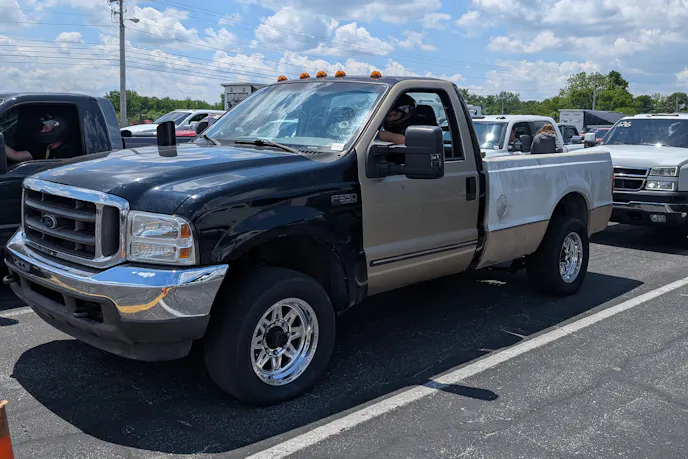
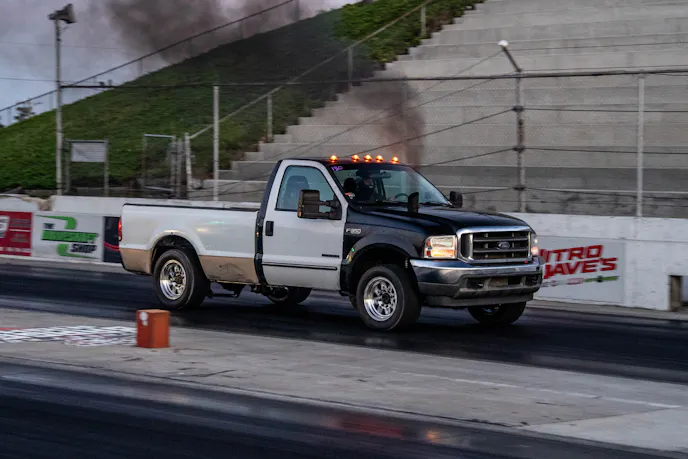
The black front clip, white bed, aged lower paint and otherwise work-truck appearance would be easy to regard as unfinished. Hurtt regards it as an asset. In fact, his favorite aspect of the F-350 is precisely that sleeper quality: it can look halfway assembled while the mechanical package underneath is anything but.
It is difficult to argue with the strategy. A glossy paint job would not make the HPOP flow more oil. Matching doors would not improve shock valving. Polished trim has yet to lower a 60-foot time.
Hurtt’s stated objective is more ambitious than simply building a quick pickup. He wants to challenge the persistent idea that the 7.3-liter Power Stroke is durable but fundamentally too slow for serious competition, and his long-term ambition is to own one of the quickest examples of the platform. For now, he is concentrating on winning races, remaining competitive and improving the combination incrementally.
That may be the most interesting thing about the truck. At the time writing, Hurtt was only 19, yet the F-350 already represents roughly four years of development. It has migrated from non-running Marketplace purchase, to roadworthy truck, to dirt-drag toy, to asphalt machine with four-link suspension, coilovers, a built drivetrain, serious HEUI hardware and enough fuel to demand close attention from every other part of the combination.
Though its paint may still look like an afterthought, the engineering does not.
You might also like
This Custom 1979 Ford Courier 4x4 Gets Cummins R2.8 Diesel Power
This rare 1979 Ford Courier 4x4 is built with a Cummins R2.8 diesel, upgraded running gear, and a fresh take on its Sasquatch heritage.