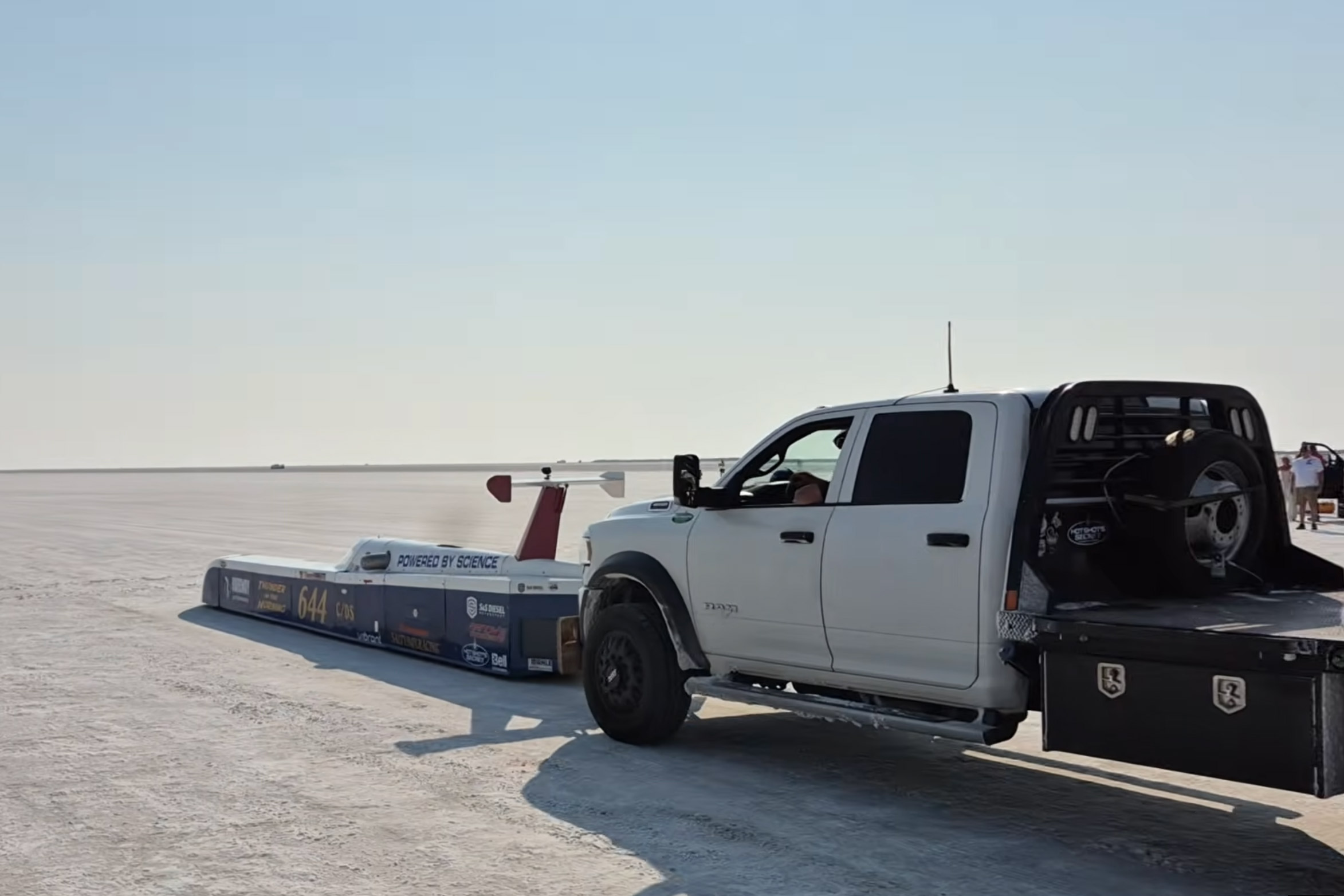
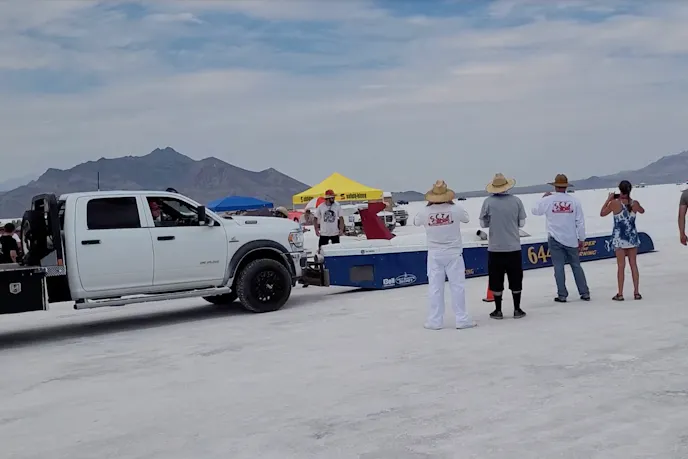
Salty Box Racing arrived at the 2026 Bonneville Speed Week with one of the most formidable diesel-powered land-speed machines ever constructed. By the end of the event, its Thunder in the Morning diesel streamliner had established two SCTA-certified records, topped 333 mph, and demonstrated an ingenious method of moving between displacement classes.
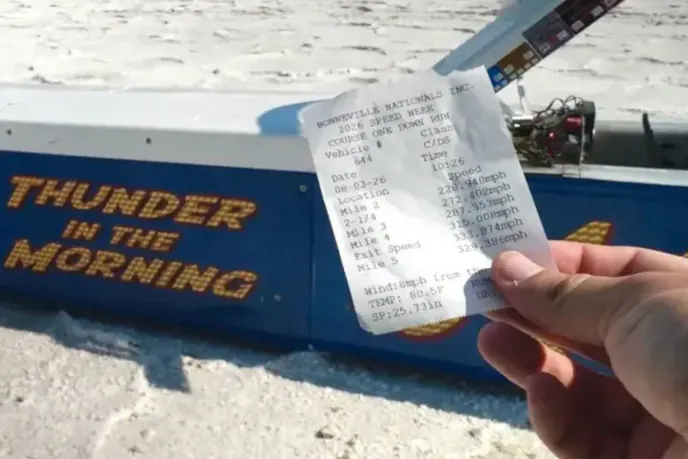
Ryan Boyle delivered the headline performance in the C/DS class, driving Thunder in the Morning to a 329.386-mph qualifying run. The streamliner was sent to impound, where it remained until the required return run. Boyle backed up the performance at 327.185 mph, producing an official two-run record average of 328.285 mph.
During the qualifying effort, the diesel streamliner also recorded a 333.874-mph exit speed. That figure was not a separate record, but it showed the car was still accelerating beyond the measured mile. The 328.285-mph average officially raised the C/DS record previously established by Tim Boyle and Salty Box Racing at 315.570 mph in 2024.
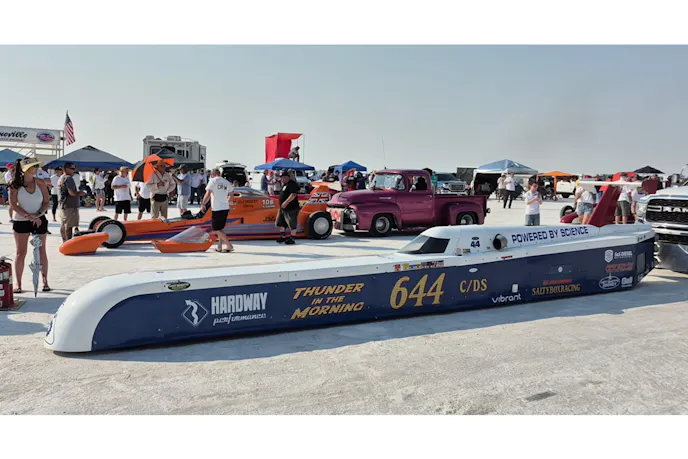
Built Around Cummins Power
At the center of Thunder in the Morning is a common-rail 5.9-liter Cummins inline-six. Fitting a heavy-duty diesel engine and its supporting systems inside a narrow streamliner originally designed for nitro power required extensive engineering and fabrication.
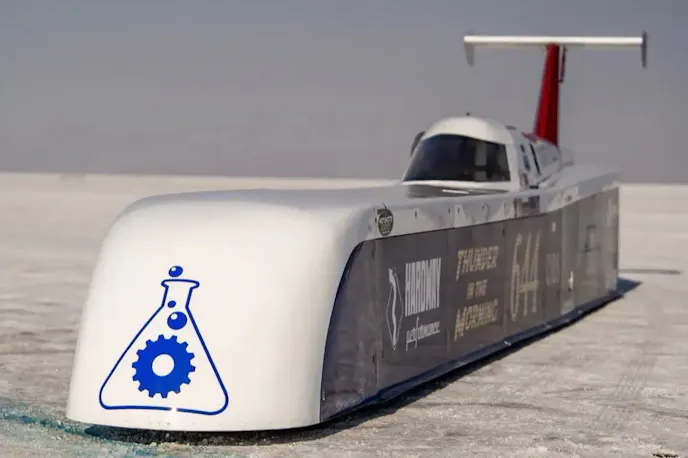
The chassis was constructed around 2015 by veteran land-speed racer Fred “Fast Freddy” Dannenfelzer. Built from 1.75-inch DOM steel and covered by a hand-formed aluminum body, the streamliner uses a rigidly mounted front axle and rear differential with no conventional suspension. Tim Boyle acquired the roller in 2019, and Salty Box Racing subsequently converted it for Cummins power.
D&J Precision Machine components help the engine survive the sustained cylinder pressure and heat generated during a Bonneville run. The build incorporates a D&J Stage 2 cylinder head, heavy-duty X-beam connecting rods, a dual-CP3 timing housing, and a billet valve cover. The dual-pump housing is particularly valuable inside the tightly packaged streamliner because it keeps the high-pressure fuel pumps tucked close to the engine.
S&S Diesel Motorsport supplies the high-pressure fuel system, including the CP3 pumps and injectors. MoTeC engine management and calibration work from Ryan Milliken and Hardway Performance control fuel delivery, boost, airflow, and engine protection during miles of wide-open-throttle operation.
Unlike a drag-racing engine that is subjected to full power for only a few seconds, a Bonneville powerplant must remain under extreme load for an extended period. Every part of the combination must work together as heat continues to build inside a body designed to minimize frontal area rather than maximize airflow.
Compound Boost And A Built 48RE
The Cummins breathes through a compound Garrett turbocharger system. An 85mm GTX5533R Gen II serves as the high-pressure turbo, while a massive 102mm G57-2750 functions as the atmospheric unit. The compound arrangement allows the engine to move an enormous volume of air while maintaining the pressure required at high engine load.
Charge-air temperature is managed through an extensive water-to-air intercooling system. One cooler is positioned between the two turbochargers, while another cools the compressed air before it enters the engine.
Earlier data logging showed the turbo system maintained 96 psi of boost for approximately 40 seconds, peaking at 113 psi. Those numbers came from previous testing rather than the 2026 record run, but they illustrate the loads the engine, cylinder head, intercoolers, and fuel system must withstand.
Power reaches the rear wheels through a heavily reinforced 48RE automatic transmission prepared by Randy’s Transmissions. The transmission was built with billet shafts, a full-manual valve body, a shortened case configuration, and a triple-disc billet torque converter. Although the 48RE originated as a Dodge truck transmission, this version was engineered to handle sustained four-digit diesel power in one of motorsports’ most demanding environments.
One Diesel Streamliner, Five Cylinders, Two Records
Salty Box Racing’s week did not end with the C/DS record. The team made quick modifications that allowed the same Cummins to operate on only five of its six cylinders, effectively moving Thunder in the Morning into the smaller D/DS displacement category. A complete 5.9-liter Cummins displaces 359 cubic inches. Operating five of its six cylinders reduces the active displacement to approximately 299 cubic inches, placing it within the D engine class. Exactly how was the sixth cylinder disabled? By taking off its injector harness.
With the car redesignated as entry 6644, Robert Murphy qualified at 236.289 mph. He returned with a substantially faster 272.809-mph run, producing an official D/DS record average of 254.549 mph.
The result gave Thunder in the Morning two records with two drivers and two operating configurations during the same Speed Week. Ryan Boyle earned the C/DS record and a blue Bonneville 300 MPH Club hat, while Murphy’s D/DS performance earned him entry into the Bonneville 200 MPH Club.
You might also like
A School Bus-Sourced 12-Vavle Cummins Powers This Awesome 1959 Chevy Apache
This awesome 1959 Chevy Apache is a combination of a $500 Marketplace find, a Ford F-250, and a Cummins turbodiesel from a school bus.