When people talk about tuning a modern diesel with EFILive, they often simplify it down to phrases like “adding fuel” or “turning it up.” In reality, EFILive doesn’t directly “add fuel” at all. What it does is give the calibrator control over a complex, torque-based control system that decides how much fuel to inject, when to inject it, and how to deliver it—hundreds of times per second.
Understanding how fueling works inside a common-rail diesel ECM is the difference between chasing smoke and building a tune that makes clean power, drives well, and lives a long time. Let’s break down that process at a high, conceptual, level. While this won’t directly teach you how to use the EFILive tuning software, our hope is that you’ll leave more informed.
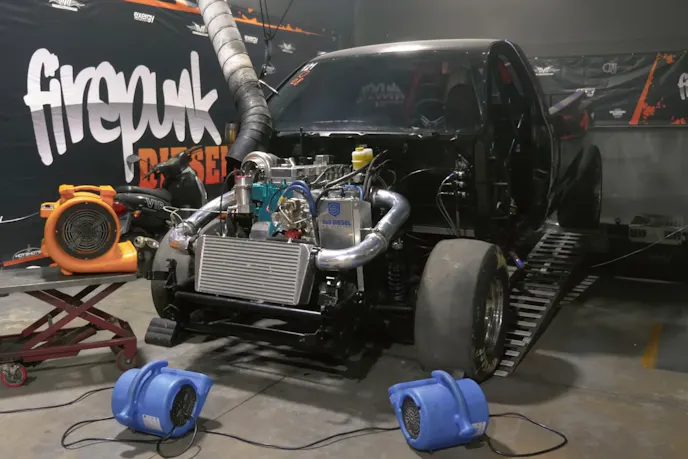
From Throttle Pedal To Torque Request
The first misconception to clear up is this: Your throttle pedal does not request fuel. It requests torque.
On modern common-rail diesels (Duramax, Cummins, Power Stroke), the accelerator pedal is simply an input device. When you press it, the ECM interprets pedal position through a series of driver-demand tables and converts that input into a requested engine torque.
This torque request is then filtered through multiple layers of logic, which include driver demand limits, engine protection limits, transmission and driveline limits, and environmental limits (temperature, altitude, etc.) Only after the ECM settles on an allowed torque value does it begin calculating how much fuel is required to make that torque under current conditions.
This is why two trucks with identical hardware can behave very differently with different tunes—even if peak horsepower numbers are similar.
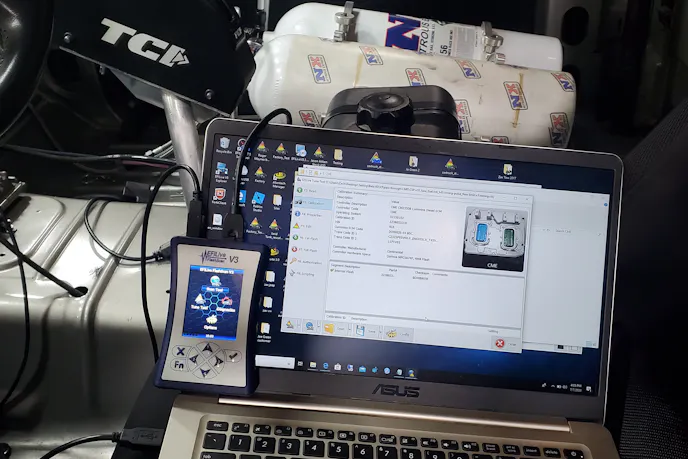
Torque Is The Master Variable
Once a final torque value is determined, everything downstream revolves around achieving that torque target as accurately and safely as possible.
The ECM now asks a critical question: “Given current engine speed, air mass, and operating conditions, how much fuel do I need to inject to make this torque?”
To answer that, the ECM relies on internal torque models. These models describe the relationship between fuel quantity, air charger, engine speed, injection timing, and combustion efficiency.
EFILive gives tuners access to parts of this model—either directly or indirectly—depending on platform and operating system. When these models are poorly calibrated, the ECM’s torque prediction becomes inaccurate, which leads to drivability problems, harsh shifts, or transmission damage.
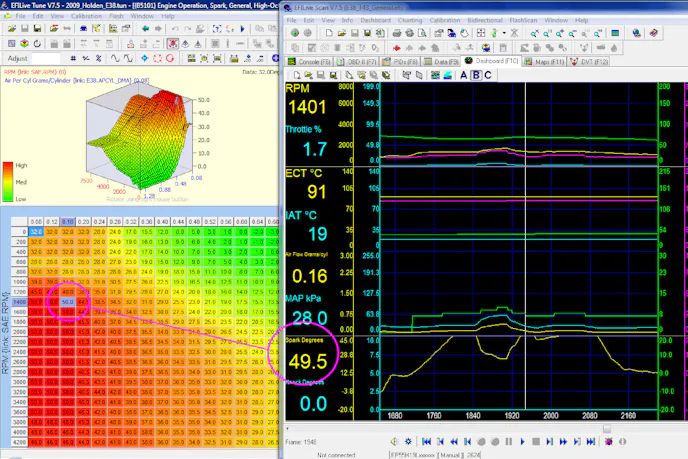
Fuel Quantity: More Than “How Much Fuel”
When enthusiasts talk about “fueling,” they usually mean fuel quantity, often measured in milligrams per stroke. But in a common-rail diesel, fuel quantity is not a single on/off value.
The ECM must decide the total fuel mass to inject, how that fuel is split across multiple injection events, how long each injection lasts, and what rail pressure is needed to deliver it accurately. EFILive allows tuning of the relationships that govern these decisions, not just the final number.
Crucially, fuel quantity is almost never commanded directly from the pedal. It’s calculated as a result of torque demand and available air.
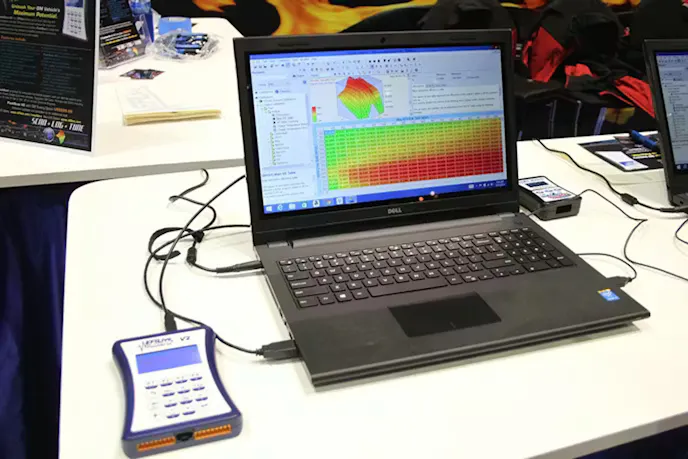
Rail Pressure: The Delivery System
Fuel quantity is meaningless without the ability to deliver it precisely. That’s where rail pressure comes in. Rail pressure determines how quickly fuel can flow through the injector for a given pulse width. Higher pressure allows for shorter injection durations, better atomization, and more precise control at higher engine speeds.
However, higher rail pressure also increases pump load, injector stress, and can add heat to the fuel system. The ECM constantly balances commanded rail pressure against fuel demand and system limits. EFILive gives tuners the ability to reshape this balance—within reason.
A well-designed tune doesn’t simply raise rail pressure everywhere. It uses pressure strategically, increasing it where control is needed and backing off where it adds unnecessary stress.
Pulse Width, Duration, And Why They Matter
Injectors don’t inject fuel by volume—they inject fuel by time. Once the ECM knows the desired fuel mass and current rail pressure it calculates an injector pulse width (or duration) that will deliver that mass of fuel.
Here’s where things get interesting.
At high engine speeds or high fuel demand, injectors can reach a point where there simply isn’t enough time in the engine cycle to inject all the requested fuel cleanly. When that happens, the ECM may extend injection later into the combustion event, split fuel across additional injections, or even limit fuel to protect combustion stability.
EFILive allows tuners to influence how these limits behave, which is why some tunes feel smooth and controlled while others feel noisy, smoky, or harsh.
Multiple Injection Events: Not Just One Shot
Modern diesels rarely inject fuel in a single event. Instead, they use multiple injection events to shape combustion. Typical events include a pilot injection (reduces noise and smooths combustion), main injection (produces the bulk of torque), and post injection (supports emissions systems or EGT management.) Each event has its own timing, duration, and purpose.
EFILive provides control over how these injections are scheduled and how they interact. Poorly calibrated injection strategies often show up as excessive diesel knock, unstable idle, or rising EGTs—even if total fuel quantity looks reasonable.
Understanding that fueling is distributed across time, not just added, is critical.
Air Mass: Fuel’s Silent Partner
Fuel alone does not make power; it requires air as well. The ECM continuously calculates available air mass using mass air flow estimation, boost pressure, intake air temperature, and volumetric efficiency models. Fuel quantity is then limited by how much air is available to burn it cleanly. This is why aggressive fueling without proper air modeling leads to smoke, heat, and poor efficiency.
EFILive doesn’t “add air,” but it allows tuners to align fueling strategies with real airflow behavior. When air and fuel models agree, the truck feels responsive and clean. When they don’t, the ECM is constantly correcting itself.
Why Bad Fueling Feels Worse Than Low Power
One of the most common complaints after a bad tune isn’t lack of power—it’s how the truck drives. Symptoms like surging, lazy throttle response, harsh shifts, and inconsistent power delivery are often the result of mismatched torque and fueling models. The ECM thinks it’s delivering one amount of torque, while the engine is producing another. The transmission, traction control, and stability systems all react based on that incorrect information.
Platform Differences Matter
While the concepts above apply broadly, each platform implements them differently.
Duramax platforms are heavily torque-modeled and tightly integrated with the Allison or 10-speed TCM.
Cummins platforms vary widely by generation, with different degrees of torque modeling and fueling authority.
Power Stroke strategies add another layer of complexity around airflow and emissions logic.
EFILive exposes different controls depending on platform and operating system, which is why tuning knowledge doesn’t always transfer cleanly from one engine to another.
The Big Takeaway
EFILive doesn’t simply let you “add fuel.”
It lets you influence how torque is requested, how fuel mass is calculated, how that fuel is delivered, and how combustion is shaped over time. The best tunes aren’t the ones with the most fuel—they’re the ones where air, fuel, timing, and torque models all agree with each other.
Once you understand that, EFILive stops feeling like a collection of tables and starts making sense as a control system.
You might also like
Leaks Be Gone: Ford 6.7-liter Power Stroke Pusher HD Upper Coolant Tube Installation
Stop messy leaks instantly. The Pusher HD Upper Coolant Tube installation replaces weak factory plastics with heavy duty metal.